
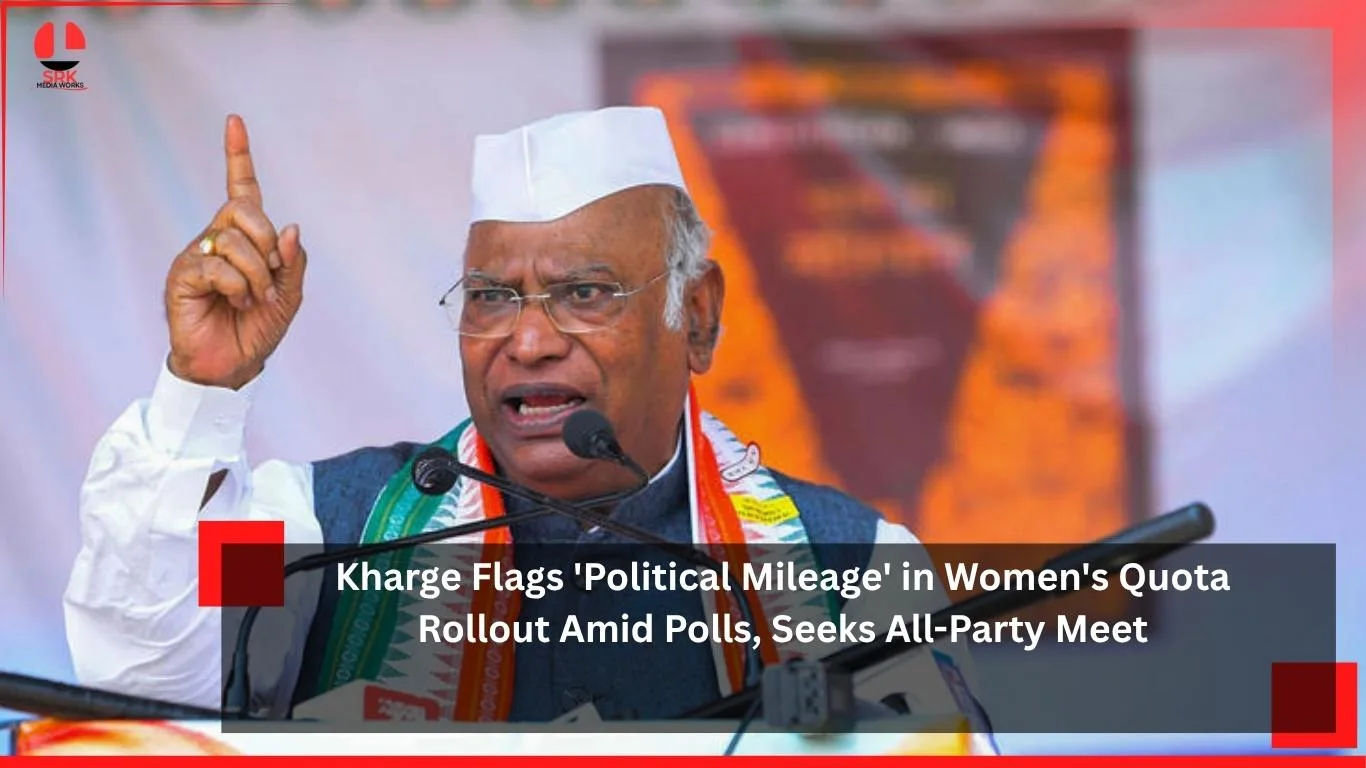
Congress president Mallikarjun Kharge has raised concerns over the timing of the women’s reservation rollout, alleging that the ruling party is attempting to gain “political mileage” ahead of elections. He has called for an all-party meeting to discuss the implementation of the women’s quota, stressing that such a transformative reform should not be reduced to electoral strategy.
Kharge’s Concerns
Kharge argued that while women’s reservation is a long-pending demand supported across political lines, its rollout during election season risks being perceived as a political maneuver. He emphasized that the issue deserves consensus and transparency, not partisan advantage.
His remarks highlight the Congress party’s position that reforms of national importance should be implemented with broad consultation rather than unilateral announcements.
Women’s Quota: Background
The women’s reservation bill, which seeks to reserve one-third of seats in legislatures for women, has been debated for decades. Supporters argue it will empower women politically, while critics caution against tokenism and demand clarity on implementation timelines.
Political Reactions
- Congress: Seeks an all-party meeting, accuses ruling party of politicizing the issue.
- BJP: Defends the timing, claiming it demonstrates commitment to women’s empowerment.
- Regional Parties: Mixed responses, with some supporting immediate implementation and others demanding clarity on representation for backward classes.
Comparative Analysis of Stakeholders
| Stakeholder | Position | Potential Gain | Potential Risk |
|---|---|---|---|
| Congress | Seeks consensus, flags political mileage | Public perception of responsibility | Risk of appearing obstructive |
| BJP | Defends timing, claims empowerment | Electoral advantage | Criticism of opportunism |
| Regional Parties | Mixed positions | Influence in negotiations | Risk of fragmentation |
| Women’s Groups | Demand clarity and speed | Greater representation | Delay in implementation |
This comparison shows how different stakeholders navigate the political and social dimensions of the women’s quota rollout.
Pivot Analysis: Impact of Women’s Quota Rollout
| Dimension | Before Announcement | After Announcement | Implications |
|---|---|---|---|
| Political Atmosphere | Focused on polls | Shifted to women’s empowerment | Electoral narratives reshaped |
| Party Strategies | Traditional campaign issues | Women’s quota dominates | New alliances possible |
| Public Perception | Demand for reform | Mixed reactions on timing | Debate on sincerity |
| Legislative Reform | Pending for decades | Revived momentum | Pressure for clarity |
The pivot analysis highlights how the announcement changes the political landscape, influencing both electoral strategies and public discourse.
Kharge’s Call for All-Party Meet
Kharge’s demand for an all-party meeting reflects his emphasis on consensus-driven politics. He argued that women’s reservation should be implemented in a way that ensures inclusivity, particularly for marginalized communities.
Broader Implications
The debate over women’s quota rollout underscores the intersection of reform and electoral politics. While the move is widely supported in principle, its timing raises questions about political intent.
Possible Outcomes
- Consensus Achieved: An all-party meeting leads to agreement on implementation.
- Continued Dispute: Parties remain divided, with accusations of politicization.
- Partial Implementation: Rollout begins with limited scope, leaving questions unresolved.
- Electoral Impact: Women’s quota becomes a central campaign issue, influencing voter sentiment.
Conclusion
Kharge’s criticism of the women’s quota rollout as an attempt at “political mileage” highlights the complexities of implementing long-pending reforms during election season. His call for an all-party meeting reflects the need for consensus and inclusivity in shaping transformative policies. The outcome of this debate will not only determine the future of women’s representation but also influence the broader electoral narrative.
Disclaimer: This article is based on reported developments and political analysis. It does not endorse any political party or leader. The content is intended for informational purposes only, highlighting how reforms intersect with electoral strategies. Readers should interpret the situation within the broader framework of Indian politics.