




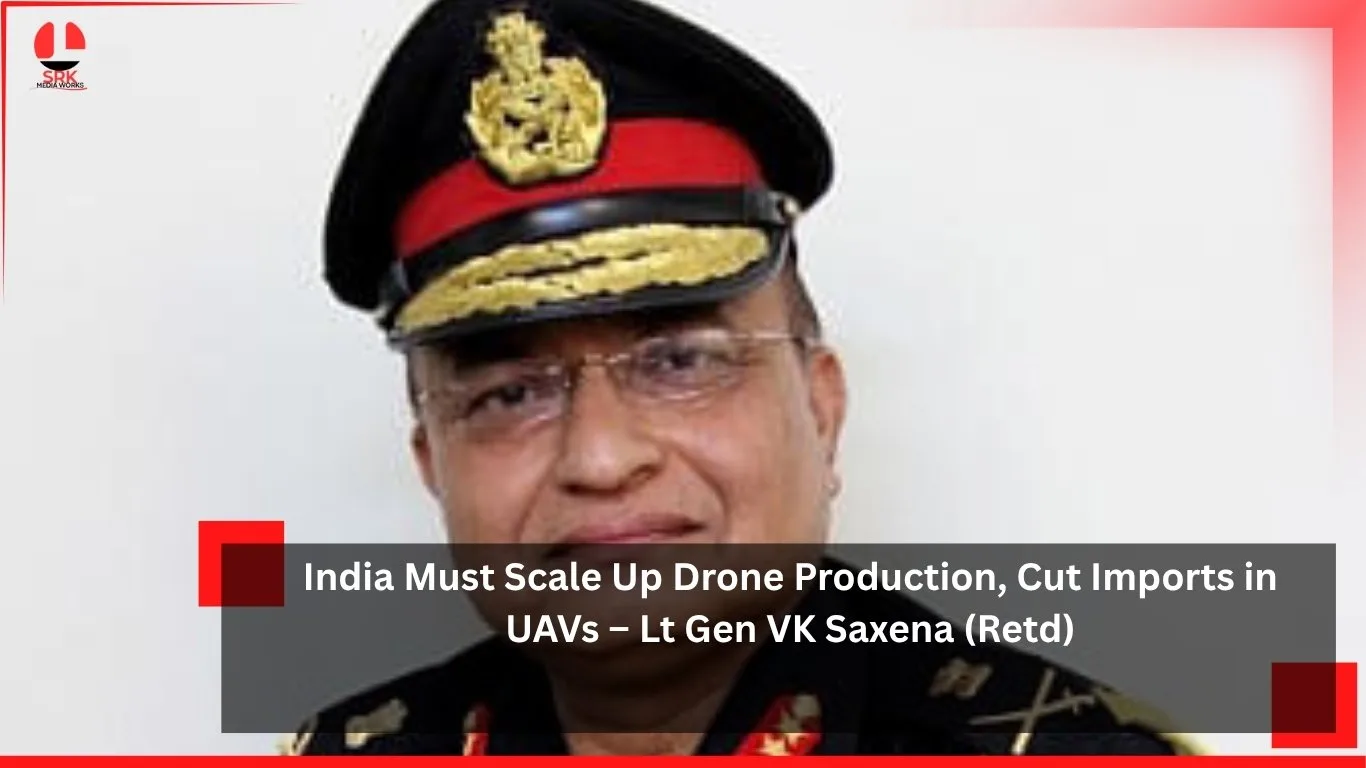
Retired Lieutenant General VK Saxena has urged India to accelerate domestic drone production and reduce dependence on imported Unmanned Aerial Vehicles (UAVs). Speaking on the strategic importance of drones in modern warfare and national security, he emphasized that India must prioritize indigenous manufacturing to strengthen defense capabilities, safeguard sovereignty, and reduce fiscal burdens.
Background: The Growing Importance of UAVs
Unmanned Aerial Vehicles (UAVs), commonly known as drones, have become indispensable in modern military operations. They are used for surveillance, reconnaissance, combat missions, logistics, and disaster management. Globally, countries are investing heavily in drone technology to gain a tactical edge.
India, while making progress in drone development, continues to rely significantly on imports for advanced UAVs. This dependence raises concerns about strategic autonomy and cost efficiency.
Lt Gen VK Saxena’s Key Points
In his remarks, Lt Gen Saxena highlighted several critical aspects:
- Strategic autonomy: India must not depend on foreign suppliers for critical defense technology.
- Cost efficiency: Imported drones are expensive, increasing defense expenditure.
- Technology transfer: Indigenous production ensures knowledge retention and innovation.
- Operational readiness: Domestic manufacturing allows faster deployment and customization.
Timeline of India’s Drone Development
| Year | Development | Impact |
|---|---|---|
| Early 2000s | Initial UAV imports for surveillance | Limited domestic capability |
| 2010s | Indigenous projects like DRDO’s Rustom | Progress but slow adoption |
| 2020s | Private sector entry into drone manufacturing | Boost in innovation |
| 2026 | Call for scaling up production | Push for self-reliance |
Comparative Analysis: Imports vs. Indigenous Production
| Factor | Imported UAVs | Indigenous UAVs |
|---|---|---|
| Cost | High due to foreign pricing | Lower with domestic production |
| Technology | Advanced but restricted | Customizable and scalable |
| Availability | Dependent on supplier | Controlled by domestic industry |
| Strategic Autonomy | Limited | Stronger national security |
| Long-term Impact | Fiscal burden | Sustainable growth |
Current Challenges
Despite progress, India faces several challenges in scaling up UAV production:
- Technology gaps in advanced combat drones.
- Limited R&D funding compared to global leaders.
- Dependence on foreign components for critical systems.
- Regulatory hurdles slowing private sector participation.
Opportunities Ahead
Lt Gen Saxena stressed that India has immense potential to become a global leader in drone technology if it leverages its strengths:
- Expanding defense-industrial base with private sector involvement.
- Government initiatives like “Make in India” and “Atmanirbhar Bharat.”
- Collaboration with startups driving innovation in UAV design.
- Dual-use applications in agriculture, disaster relief, and logistics.
Global Context
Countries like the United States, Israel, and China have already established dominance in UAV technology. India’s push for indigenous production is not just about defense but also about competing in the global drone market.
Conclusion
Lt Gen VK Saxena’s call to scale up drone production and cut imports underscores the urgency of achieving self-reliance in UAV technology. As drones become central to modern warfare and national security, India must invest in indigenous manufacturing, strengthen R&D, and encourage private sector participation. The path to a drone-powered future lies in reducing dependence on imports and building a robust domestic ecosystem.
Disclaimer
This article is based on reported statements and independent defense analysis. It does not confirm or deny specific government policies or military procurement decisions. Readers should treat the content as interpretative reporting rather than definitive official documentation.