

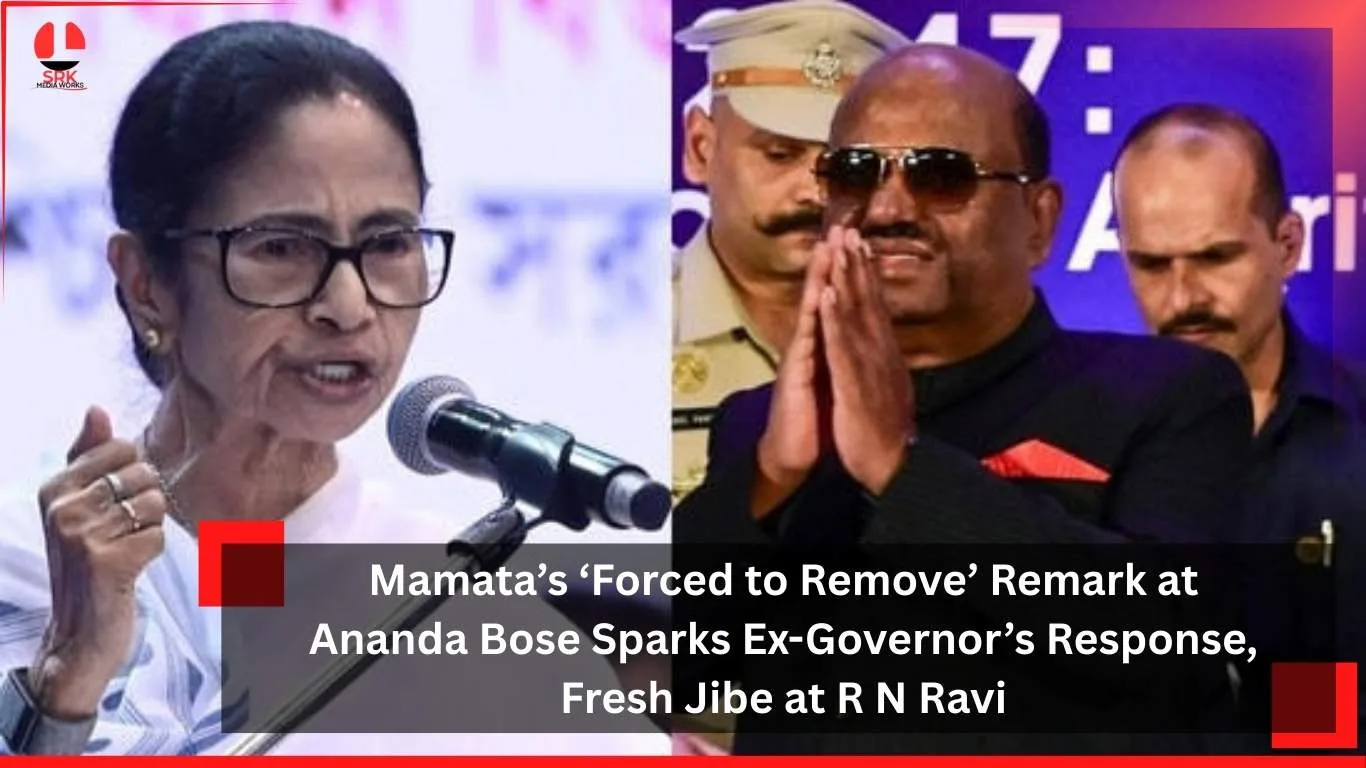
West Bengal Chief Minister Mamata Banerjee’s sharp criticism of Governor C.V. Ananda Bose has reignited political tensions, drawing a counter-response from former Governor Jagdeep Dhankhar and prompting a fresh jibe at Tamil Nadu Governor R.N. Ravi. The episode underscores the increasingly strained relationship between state governments and governors appointed by the Centre, a recurring theme in Indian federal politics.
Context of Mamata’s Remark
During a recent public address, Mamata Banerjee alleged that she was “forced to remove” Governor Ananda Bose from certain ceremonial roles, citing interference in administrative matters. Her statement was not just a critique of Bose but also a broader attack on what she perceives as the Centre’s attempts to undermine state autonomy.
This remark quickly gained traction, as it highlighted the ongoing friction between Raj Bhavan and Nabanna (the state secretariat). Mamata’s words were seen as a continuation of her long-standing narrative that governors often act as political agents rather than neutral constitutional heads.
Ex-Governor Dhankhar’s Response
Former West Bengal Governor Jagdeep Dhankhar, now serving as Vice President of India, responded to Mamata’s barb by defending the constitutional role of governors. He emphasized that governors are duty-bound to uphold the Constitution and cannot be sidelined by political rhetoric.
Dhankhar’s intervention added weight to the debate, given his own history of confrontations with Mamata during his tenure as Governor. His response suggested that Mamata’s criticism was not just about Bose but part of a larger pattern of her clashes with governors.
Fresh Jibe at R N Ravi
Interestingly, Mamata’s remarks also carried an indirect jibe at Tamil Nadu Governor R.N. Ravi, who has faced similar criticism from the DMK government. Ravi has been accused of delaying bills, altering speeches, and interfering in state matters. By linking Bose’s actions with Ravi’s controversies, Mamata sought to portray a nationwide trend of governors overstepping their constitutional boundaries.
This rhetorical strategy allowed Mamata to position herself as part of a broader coalition of opposition leaders challenging what they see as central overreach.
Historical Pattern of Governor-State Clashes
Governor-state conflicts are not new in India. From the Emergency era to contemporary times, governors have often been accused of acting as political instruments of the ruling party at the Centre.
Some notable examples include:
- West Bengal: Jagdeep Dhankhar vs Mamata Banerjee (2019–2022)
- Tamil Nadu: R.N. Ravi vs M.K. Stalin (2021–present)
- Kerala: Arif Mohammed Khan vs Pinarayi Vijayan
- Maharashtra: Bhagat Singh Koshyari vs Uddhav Thackeray
These confrontations often revolve around issues such as assent to bills, appointments in universities, and ceremonial protocols.
Comparative Analysis of Governor-State Relations
| State | Governor | Chief Minister | Nature of Conflict |
|---|---|---|---|
| West Bengal | C.V. Ananda Bose | Mamata Banerjee | Administrative interference, protocol disputes |
| Tamil Nadu | R.N. Ravi | M.K. Stalin | Altered speeches, bill delays |
| Kerala | Arif Mohammed Khan | Pinarayi Vijayan | University appointments, autonomy |
| Maharashtra | B.S. Koshyari | Uddhav Thackeray | Political statements, governance issues |
Political Implications
Mamata’s remarks serve multiple political purposes:
- Mobilizing Support: By portraying herself as a defender of state rights, she appeals to regional pride.
- Opposition Unity: Her jibe at R.N. Ravi resonates with DMK and other opposition parties, strengthening alliances.
- Electoral Strategy: With upcoming elections, Mamata is keen to frame the Centre as authoritarian, using governors as symbols of interference.
Pivot Analysis of Governor-State Conflicts
| Dimension | West Bengal | Tamil Nadu | Kerala | Maharashtra |
|---|---|---|---|---|
| Frequency of Clashes | High | High | Moderate | Moderate |
| Public Statements | Aggressive | Aggressive | Defensive | Mixed |
| Impact on Governance | Significant | Significant | Limited | Moderate |
| Opposition Narrative | Strong | Strong | Moderate | Moderate |
Broader Federal Concerns
The recurring disputes raise fundamental questions about India’s federal structure:
- Should governors have discretionary powers beyond ceremonial roles?
- How can states ensure autonomy while respecting constitutional provisions?
- Is there a need to revisit the appointment process of governors to reduce political bias?
Legal experts argue that while governors are meant to act as neutral arbiters, the reality often reflects political alignments. This undermines trust between state governments and Raj Bhavans.
Conclusion
Mamata Banerjee’s “forced to remove” remark against Ananda Bose is more than a personal attack; it is a political statement against the perceived erosion of state autonomy. The subsequent response from Jagdeep Dhankhar and the indirect jibe at R.N. Ravi highlight the national dimension of governor-state conflicts.
As India heads into crucial electoral cycles, these confrontations are likely to intensify, shaping both governance and political narratives. The debate over the role of governors remains unresolved, but one thing is clear: they continue to be pivotal players in India’s federal drama.
Disclaimer
This article is a journalistic analysis based on publicly available information and political statements. It does not represent endorsement of any political party or individual. Readers are encouraged to verify facts independently and view the content as part of ongoing democratic discourse.