





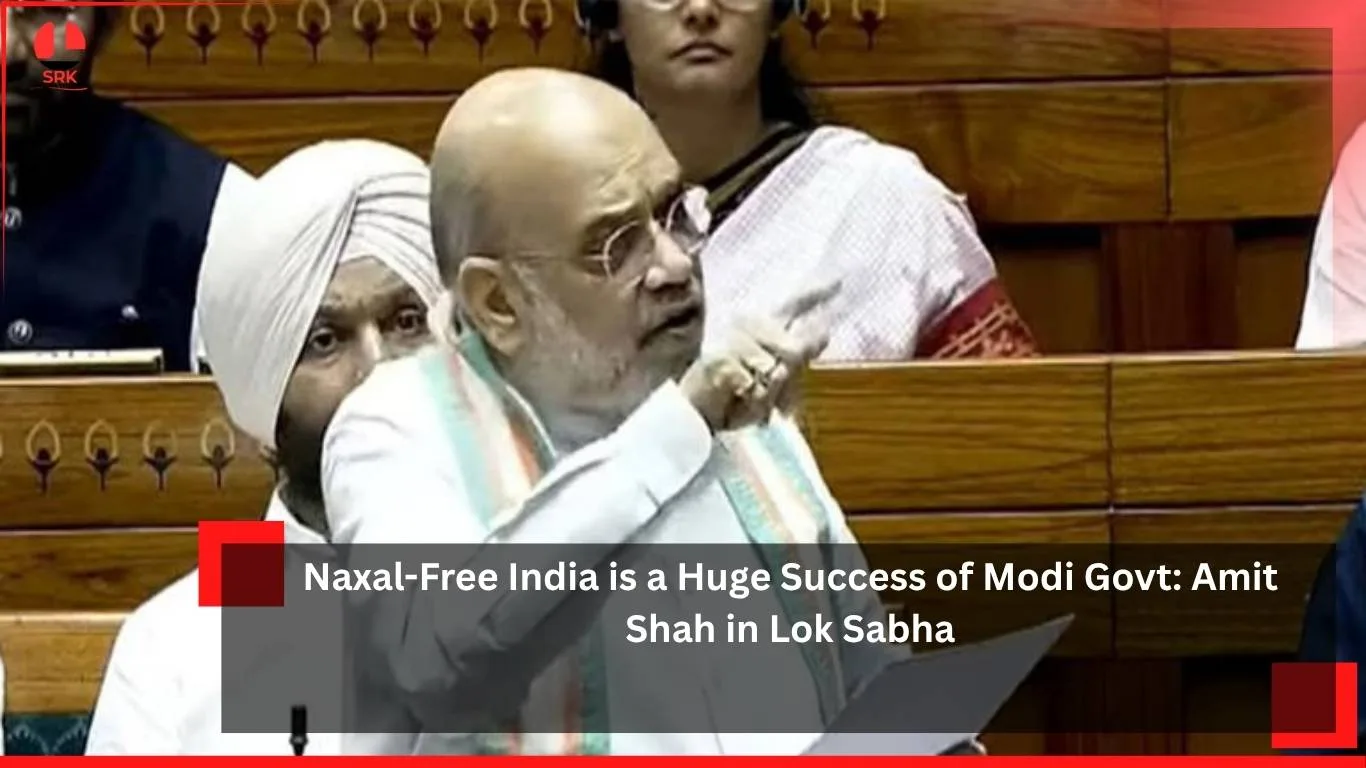
Union Home Minister Amit Shah declared in the Lok Sabha that India has effectively become “Naxal-free,” calling it one of the biggest achievements of the Modi government. His statement highlighted the decline of Left-Wing Extremism (LWE) across the country, attributing the success to a combination of strong security measures, development initiatives, and improved coordination between central and state agencies.
Background: The Naxal Challenge
For decades, Naxalism posed a serious internal security threat in India. Originating in West Bengal in the late 1960s, the movement spread across several states, particularly in the “Red Corridor” covering parts of Chhattisgarh, Jharkhand, Odisha, Bihar, and Maharashtra. The insurgency was marked by violent attacks on security forces, infrastructure, and civilians.
Amit Shah’s Statement in Parliament
In his address, Amit Shah emphasized that the Modi government’s policies had successfully dismantled the organizational and operational capabilities of Naxal groups. He credited:
- Enhanced security operations with modern technology.
- Development projects in affected regions, including roads, schools, and healthcare.
- Improved intelligence sharing between central and state agencies.
- Community engagement to win the trust of local populations.
Timeline of Naxal Decline
| Year | Development | Impact |
|---|---|---|
| 2014 | Modi govt begins intensified anti-Naxal strategy | Stronger security presence |
| 2016 | Launch of development schemes in Red Corridor | Improved local infrastructure |
| 2019 | Decline in Naxal-related incidents | Greater civilian confidence |
| 2024 | Major Naxal leaders neutralized | Organizational collapse |
| 2026 | Amit Shah declares India Naxal-free | Political and security milestone |
Comparative Analysis: Past vs. Present
| Factor | Before 2014 | After 2024 |
|---|---|---|
| Naxal Presence | Widespread across 90+ districts | Limited to a few pockets |
| Civilian Casualties | High due to frequent attacks | Sharp decline |
| Security Forces Casualties | Significant losses | Reduced incidents |
| Development Projects | Limited reach | Expanded infrastructure |
| Public Sentiment | Fear and distrust | Confidence and stability |
Political Significance
Amit Shah’s declaration carries strong political weight. It positions the Modi government as having delivered on a long-standing national security challenge. The claim of a “Naxal-free India” is likely to be highlighted in upcoming political campaigns, reinforcing the government’s narrative of strong governance and decisive action.
Reactions from Opposition and Experts
- Opposition parties: Some leaders questioned whether Naxalism has been completely eradicated, pointing to sporadic incidents in certain states.
- Security experts: Many acknowledged the significant decline but cautioned that vigilance must continue to prevent resurgence.
- Civil society groups: Welcomed the reduction in violence but stressed the need for sustained development and rehabilitation of affected communities.
Broader Implications
The decline of Naxalism has several implications:
- Economic growth: Greater stability in previously affected regions opens opportunities for investment.
- Social development: Improved access to education and healthcare for marginalized communities.
- Security focus shift: Resources can now be redirected to other emerging threats.
Conclusion
Amit Shah’s announcement in the Lok Sabha that India is now “Naxal-free” marks a historic moment in the country’s internal security narrative. While challenges remain in ensuring long-term stability and development, the decline of Left-Wing Extremism is undeniably a major success for the Modi government. The achievement reflects a blend of military strength, governance reforms, and community engagement, reshaping India’s fight against insurgency.
Disclaimer
This article is based on reported parliamentary statements and independent analysis. It does not confirm or deny the complete eradication of Naxalism but interprets the government’s position and its implications. Readers should treat the content as analytical reporting rather than definitive security documentation.