



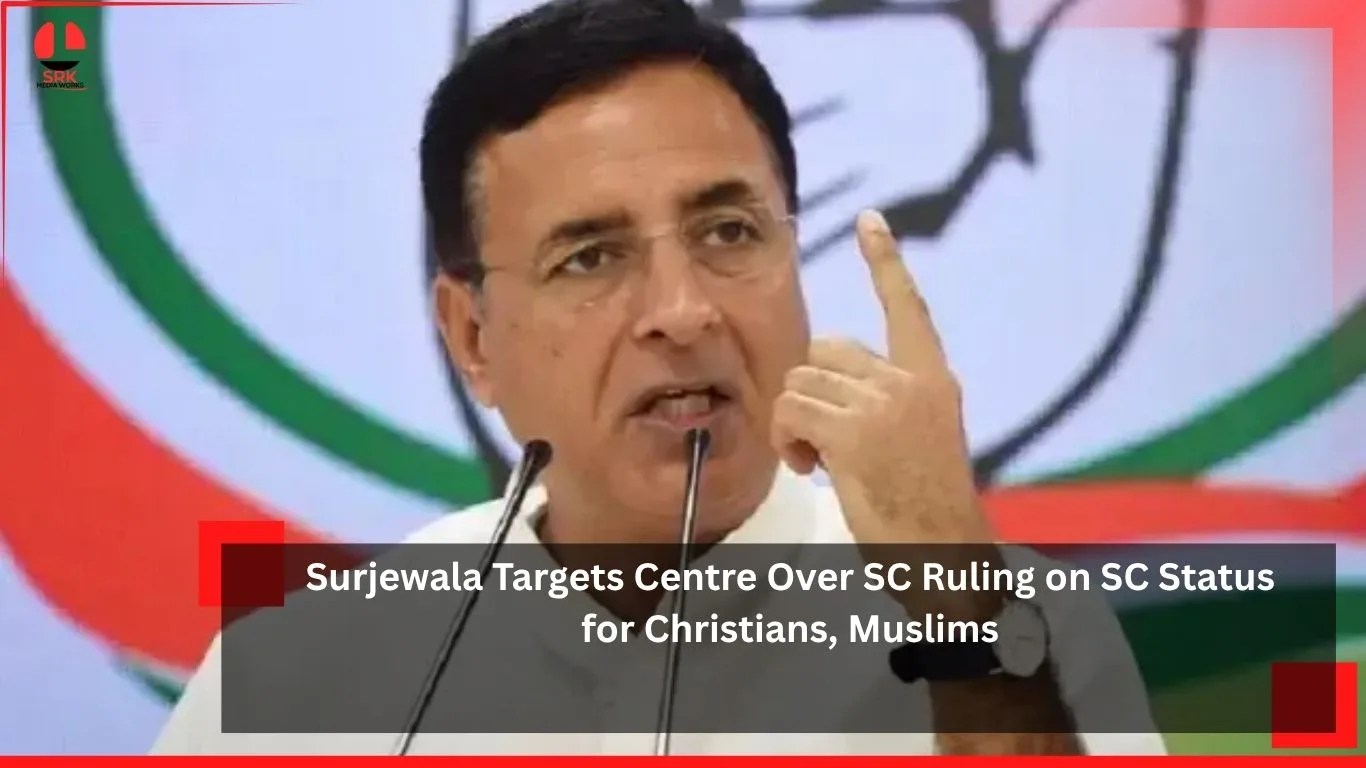
Congress leader Randeep Singh Surjewala has launched a sharp attack on the Centre following the Supreme Court’s ruling that denied Scheduled Caste (SC) status to Christians and Muslims, accusing the government of failing to uphold constitutional values of equality and justice. His remarks have reignited a long-standing debate over caste-based reservations and the rights of Dalits who convert to minority religions.
Background of the Supreme Court Ruling
- Verdict: The Supreme Court upheld that Dalits who convert to Christianity or Islam cannot claim Scheduled Caste identity.
- Legal Basis: The ruling is rooted in the 1950 Presidential Order, which restricted SC benefits to Hindus, later extended to Sikhs and Buddhists.
- Impact: Dalits who embrace Christianity or Islam lose access to reservations and protections accorded to Scheduled Castes.
Surjewala’s Criticism
Surjewala accused the Centre of deliberately ignoring the plight of Dalits who convert to minority religions.
- Denial of Rights: He argued that the government is denying constitutional protections to marginalized communities.
- Political Motive: Surjewala suggested that the ruling reflects the Centre’s reluctance to extend benefits beyond certain religious groups.
- Call for Equality: He demanded that SC status be granted irrespective of religion, emphasizing that caste discrimination persists across faiths.
Comparative Analysis of SC Status Across Religions
| Religion | SC Status Eligibility | Year of Inclusion | Notes |
|---|---|---|---|
| Hinduism | Eligible | 1950 | Original Presidential Order |
| Sikhism | Eligible | 1956 | Extended inclusion |
| Buddhism | Eligible | 1990 | Extended inclusion |
| Christianity | Not eligible | – | Excluded |
| Islam | Not eligible | – | Excluded |
Sector-Wise Impact of the Ruling
| Sector | Impact | Outlook |
|---|---|---|
| Dalit Communities | Loss of reservation benefits | Increased marginalization |
| Politics | Heated debates | Stronger opposition criticism |
| Judiciary | Reinforced precedent | Calls for review |
| Education | Reduced access to reserved seats | Lower representation |
| Employment | Limited opportunities | Widening inequality |
Why the Debate Matters
- Caste Discrimination Across Religions: Studies show caste-based discrimination persists even after conversion.
- Social Justice: Denying SC status to Christians and Muslims raises questions about equal treatment under the Constitution.
- Political Ramifications: The ruling could influence minority votes and deepen divides.
- Judicial Precedent: Reinforces the interpretation of the 1950 order, limiting scope for reform.
Challenges Ahead
- Legal Reform: Amending the Presidential Order requires political will.
- Social Inclusion: Ensuring Dalits across religions receive equal protection remains a challenge.
- Political Consensus: Opposition parties demand change, but consensus is elusive.
- Grassroots Impact: Dalit Christians and Muslims face continued exclusion from affirmative action programs.
Long-Term Implications
- Minority Rights: The ruling could intensify demands for broader recognition of caste discrimination.
- Political Mobilization: Opposition parties may use the issue to rally support.
- Judicial Review: Future petitions may seek reconsideration of the 1950 order.
- Social Equity: Without reform, disparities among Dalits of different religions may widen further.
Conclusion
Surjewala’s sharp criticism of the Centre following the Supreme Court’s ruling on SC status for Christians and Muslims highlights the deep divisions in India’s approach to caste-based reservations. While the judiciary has upheld the 1950 Presidential Order, the political and social debate over equality and justice continues to intensify. The issue underscores the need for a broader conversation on caste discrimination that transcends religious boundaries.
Disclaimer
This article is intended for informational purposes only and does not constitute legal or political advice. The views expressed are based on reported developments as of March 2026. Readers should consider multiple perspectives before forming conclusions about constitutional rights and social justice.