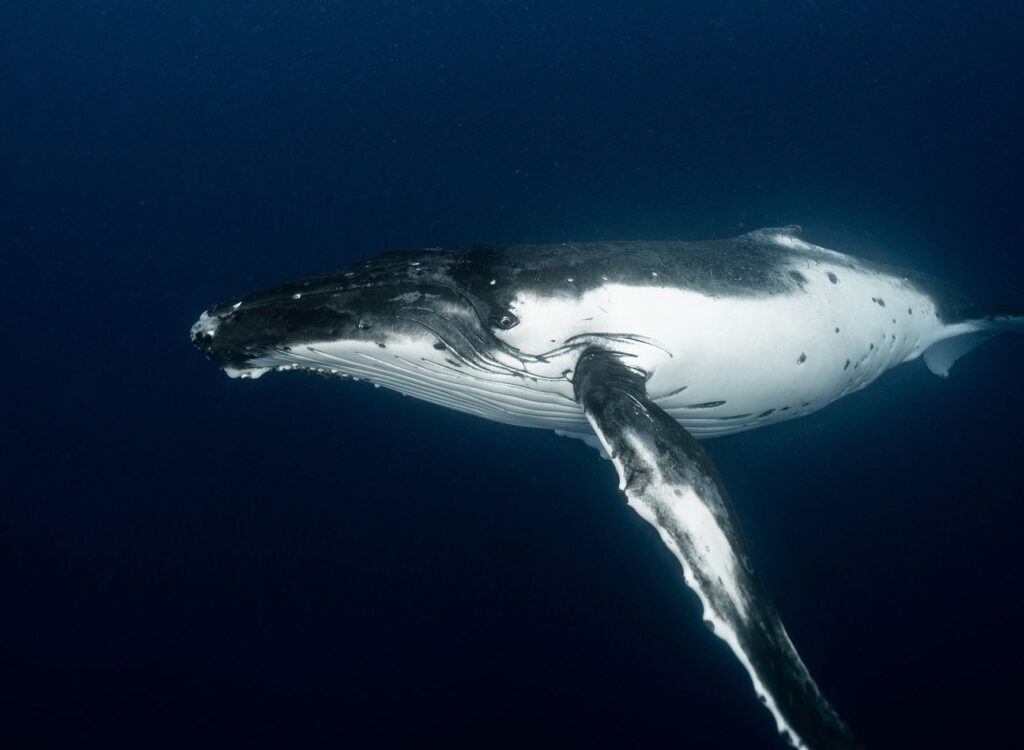

Marine biologists have resolved a multi-million-year-old evolutionary mystery by demonstrating how blue whales use ultra-low-frequency vocalizations to hide from predatory killer whales in plain hearing. The findings, published this month in a landmark marine ecology study, show that these giant mammals employ “acoustic crypsis” as an evolutionary shield to survive in the open ocean. By singing at frequencies below the hearing threshold of their primary predators, the world’s largest creatures have managed to navigate dangerous waters undetected for millennia.
The Evolutionary Battle of the Oceans
For millions of years, the open oceans have hosted a silent arms race between baleen whales and apex predators like killer whales (Orcinus orca). Unlike terrestrial prey that can hide behind physical barriers like trees or rocks, blue whales (Balaenoptera musculus) spend their lives in an open, blue void with nowhere to hide.
To survive, these massive creatures evolved a “flight” strategy rather than a “fight” strategy to escape danger. However, fleeing is only effective if the predator does not detect the prey before the escape begins.
Historically, scientists puzzled over why blue whales produce some of the loudest sounds in the animal kingdom, yet rarely fall victim to killer whale attacks on the scale of other marine mammals. The answer lies not in the volume of their songs, but in their pitch, which acts as a form of auditory camouflage.
Deciphering the Low-Frequency Shield
The research team analyzed decades of acoustic data, mapping the vocalizations of blue whales against the known hearing sensitivities of killer whales. They discovered that blue whales consistently sing at infrasonic frequencies, typically between 10 and 40 Hertz.
In contrast, killer whales have hearing systems optimized for much higher frequencies. Orcas typically detect sounds starting around 500 Hertz and ranging up to 100,000 Hertz, which they use for echolocation and social communication.
This stark divergence means that even though a blue whale’s song can travel across entire ocean basins, a nearby killer whale remains completely oblivious to it. The giants are essentially screaming in an acoustic spectrum that their predators cannot perceive.
Millions of Years of Natural Selection
This acoustic mismatch is not a coincidence, but a direct result of millions of years of natural selection. Early ancestors of baleen whales that vocalized at higher frequencies were likely heavily preyed upon by ancient pack-hunting cetaceans.
Over generations, individuals that mutated to produce lower-frequency sounds experienced significantly higher survival rates. This evolutionary pressure gradually pushed the entire communication system of blue whales into the infrasonic spectrum.
“This is a classic example of acoustic crypsis,” says Dr. Sarah Jenkins, a lead marine bioacoustician who participated in the analysis. “It is the auditory equivalent of a tiger’s stripes or a chameleon’s color-changing skin, adapted specifically for the physics of the deep ocean.”
Analyzing the Acoustic Data
The study utilized advanced hydrophone arrays deployed across the Pacific and Atlantic oceans to capture whale vocalizations. Researchers simulated predator-prey encounters using acoustic modeling software to verify how sound waves propagate through varying water temperatures and pressures.
The models confirmed that low-frequency waves travel immense distances without losing integrity, while simultaneously remaining undetectable to orcas even at close range. This dual advantage allows blue whales to coordinate migrations and find mates across thousands of miles without alerting nearby predators.
However, the data also highlighted a growing vulnerability. While natural predators cannot hear these deep songs, modern industrial machinery can, creating a new set of ecological challenges.
Anthropogenic Threats to the Silent Shield
The discovery carries significant implications for modern marine conservation and the global shipping industry. Human activities, particularly commercial shipping, oil exploration, and military sonar, generate massive amounts of low-frequency underwater noise.
This anthropogenic hum directly overlaps with the exact frequencies blue whales use for their acoustic crypsis. By filling the ocean with low-frequency noise, human activity is effectively stripping away the evolutionary camouflage that has protected these giants for millions of years.
In the coming years, researchers plan to monitor how rising ocean noise levels affect blue whale masking and predator-prey dynamics. Conservationists are already calling for stricter international regulations on vessel noise limits in critical whale migration corridors.
As global shipping lanes expand, the pressure on international maritime bodies to mandate quieter propulsion technologies will likely intensify. Protecting this ancient, silent dialogue remains paramount to ensuring the survival of the ocean’s largest inhabitants in an increasingly noisy world.