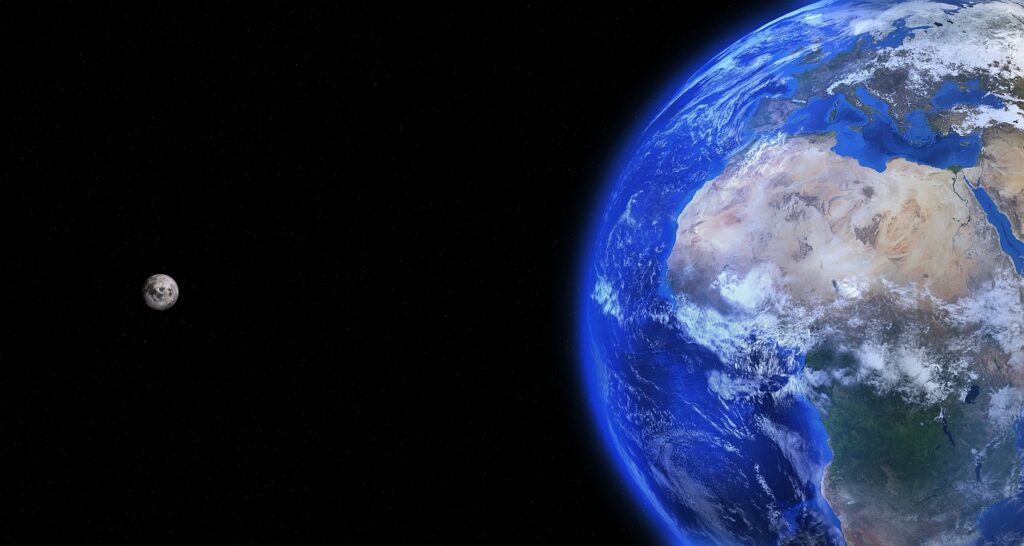

NASA scientists and planetary researchers have confirmed that the Moon is gradually drifting away from Earth at a rate of approximately 3.8 centimeters (1.5 inches) per year. This slow cosmic retreat, measured using high-precision laser reflectors placed on the lunar surface during the Apollo missions, is gradually slowing Earth’s rotation. Over billions of years, this celestial migration will fundamentally alter our planet’s day length, tidal systems, and night skies.
The Mechanics of the Lunar Retreat
The phenomenon of lunar drift is driven by gravitational interactions between Earth and its natural satellite. The gravitational pull of the Moon creates tidal bulges in Earth’s oceans, which act as a drag on the planet’s rotation.
Because Earth rotates faster than the Moon orbits it, these tidal bulges pull the Moon forward in its orbit. This gravitational tug transfers energy to the Moon, pushing it into a higher, wider orbit. Consequently, as the Moon gains energy and ascends, Earth loses rotational energy, causing our planet’s spin to decelerate.
A History of Shorter Days
To understand the scale of this change, scientists look to Earth’s geological past. Researchers at the University of Wisconsin-Madison recently analyzed 1.4-billion-year-old rock formations to reconstruct the ancient Earth-Moon relationship. Their findings revealed that 1.4 billion years ago, a day on Earth lasted just over 18 hours because the Moon was significantly closer.
Over geological epochs, the gradual retreat of the Moon has stretched our days to the 24-hour cycle we experience today. This deceleration is ongoing, adding roughly 74 thousandths of a second to the length of a day every year. While imperceptible to humans, this cumulative effect will eventually add hours to the daily cycle over hundreds of millions of years.
The Death of the Total Solar Eclipse
One of the most dramatic visual consequences of this drift is the eventual disappearance of total solar eclipses. Currently, we live in a unique cosmic window where the Moon is at the perfect distance to precisely cover the Sun’s disk during an eclipse. This alignment occurs because the Sun is about 400 times larger than the Moon, but also about 400 times farther away.
As the Moon continues its outward journey, its apparent size in our sky will shrink. In approximately 600 million years, the Moon will have drifted too far to completely block the Sun’s light. From that point forward, humanity—or whatever species inhabits Earth—will only witness annular eclipses, often referred to as ‘ring of fire’ eclipses.
Ecological and Environmental Impacts
Beyond the visual changes in our sky, the weakening of lunar gravity will have profound ecological consequences. The Moon’s gravitational pull is the primary driver of Earth’s ocean tides. As the Moon moves further away, the intensity of these tides will diminish significantly.
Coastal ecosystems, which rely on strong tidal currents to cycle nutrients and support marine life, will face severe disruption. Species that inhabit intertidal zones, such as crabs, mollusks, and various marine plants, have evolved specifically to thrive in fluctuating water levels. Weaker tides could lead to a collapse of these habitats, impacting global fisheries and coastal biodiversity.
Furthermore, the stabilization of Earth’s axial tilt is heavily dependent on the Moon’s presence. Without a large, nearby satellite to stabilize our planet’s wobble, Earth’s tilt could become highly unstable over hundreds of millions of years. This instability could trigger extreme climate shifts, swinging the planet between intense ice ages and scorching global warmth.
What to Watch Next
In the coming decades, scientists will continue to utilize advanced laser ranging stations to monitor the Moon’s distance with sub-millimeter accuracy. These measurements are crucial for refining our understanding of tidal dissipation and the internal structure of both Earth and the Moon. Upcoming lunar exploration initiatives, such as NASA’s Artemis program, will deploy new instruments to study the Moon’s seismic activity and geological history.
As space agencies establish a permanent human presence on the Moon, researchers will gain unprecedented opportunities to study these gravitational dynamics from the lunar surface itself. While the immediate survival of humanity is not threatened by this slow-motion departure, tracking the Moon’s retreat remains vital for modeling the long-term habitability of our planet.