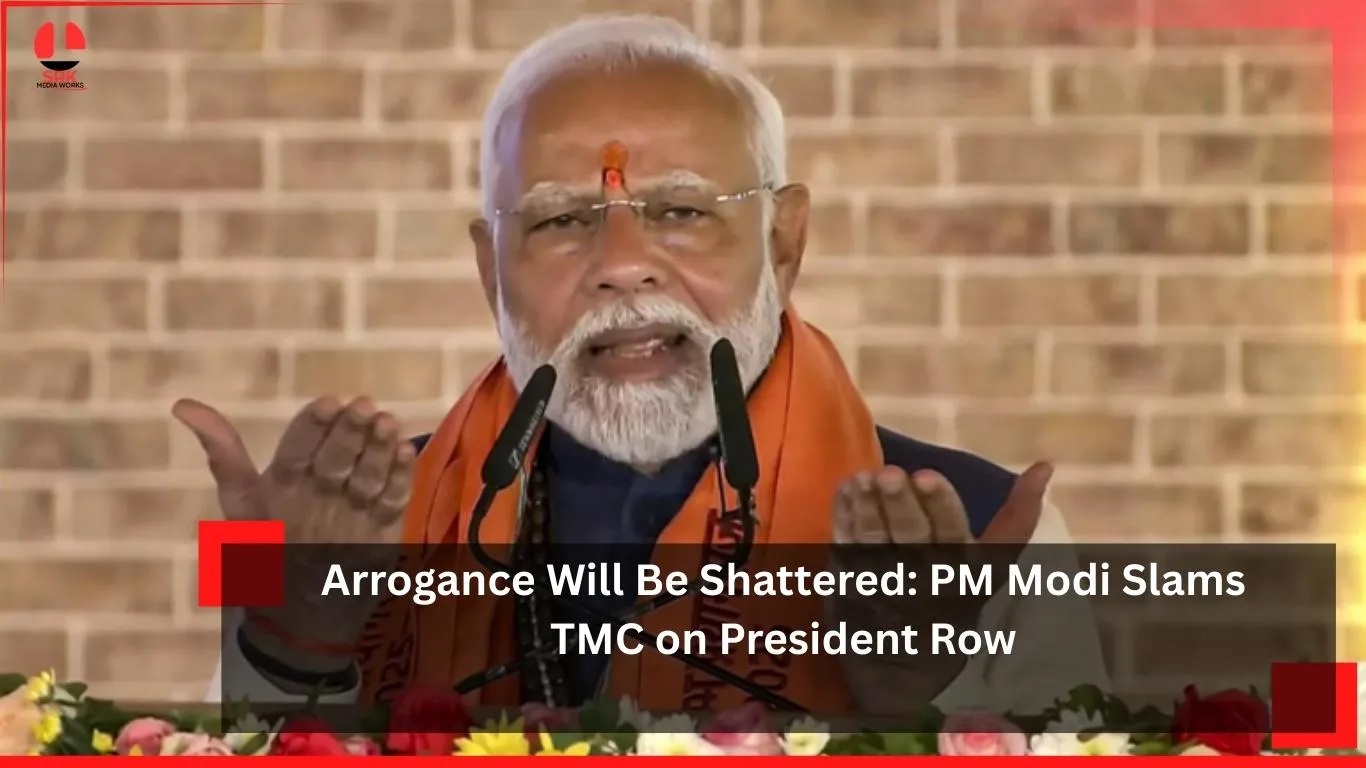
Prime Minister Narendra Modi launched a scathing attack on the Trinamool Congress (TMC), declaring that “arrogance will be shattered” in the ongoing row over the President’s role and protocol in West Bengal. His remarks have added fuel to the already heated political atmosphere, where the tussle between the Centre and the state continues to dominate headlines.
Context of the President Row
The controversy began when TMC leaders accused the Centre of undermining the dignity of the President of India during official events in West Bengal. Mamata Banerjee and her party alleged that the state government was being sidelined in matters of protocol, while the Governor and central representatives were being given undue prominence.
PM Modi, in response, strongly criticized TMC’s stance, asserting that disrespecting constitutional offices and indulging in arrogance would not be tolerated. His statement, “arrogance will be shattered,” was seen as a direct challenge to Mamata Banerjee’s political narrative.
PM Modi’s Attack on TMC
During his speech, Modi accused TMC of politicizing constitutional matters and attempting to create unnecessary conflict. He emphasized that the President of India represents the entire nation, not just one political party or state, and any attempt to undermine that dignity reflects poorly on those making such claims.
He further added that the people of West Bengal are watching closely and will not accept arrogance or disrespect towards national institutions. Modi’s remarks were designed to resonate with voters, framing TMC as a party that prioritizes political theatrics over governance.
TMC’s Counter-Narrative
TMC leaders, including Mamata Banerjee, have maintained that the Centre is deliberately using constitutional offices to interfere in state matters. They argue that the Governor and central representatives often bypass the state government, undermining federal principles.
Banerjee has repeatedly accused the BJP of attempting to weaken state autonomy, portraying herself as a defender of West Bengal’s rights. Her narrative positions TMC as a party standing against authoritarianism and central overreach.
Historical Pattern of Centre-State Clashes
The current row is part of a larger pattern of confrontations between the Centre and opposition-led states. Similar disputes have been witnessed in:
- Tamil Nadu: Governor R.N. Ravi vs DMK government over bill delays and altered speeches.
- Kerala: Governor Arif Mohammed Khan vs Left government over university appointments.
- Maharashtra: Governor Bhagat Singh Koshyari vs Shiv Sena-led government over political statements.
These conflicts highlight the recurring tension in India’s federal structure, where governors often become focal points of political battles.
Comparative Analysis of Governor-State Relations
| State | Governor | Chief Minister | Nature of Conflict |
|---|---|---|---|
| West Bengal | C.V. Ananda Bose | Mamata Banerjee | Protocol disputes, administrative interference |
| Tamil Nadu | R.N. Ravi | M.K. Stalin | Bill delays, altered speeches |
| Kerala | Arif Mohammed Khan | Pinarayi Vijayan | University autonomy issues |
| Maharashtra | B.S. Koshyari | Uddhav Thackeray | Political statements, governance clashes |
Pivot Analysis of Centre vs State Clashes
| Dimension | West Bengal | Tamil Nadu | Kerala | Maharashtra |
|---|---|---|---|---|
| Frequency of Clashes | High | High | Moderate | Moderate |
| Public Statements | Aggressive | Aggressive | Defensive | Mixed |
| Impact on Governance | Significant | Significant | Limited | Moderate |
| Opposition Narrative | Strong | Strong | Moderate | Moderate |
Political Implications
PM Modi’s remarks carry significant political weight:
- Electoral Messaging: By framing TMC as arrogant, Modi aims to connect with voters who may feel disillusioned with state governance.
- National Narrative: His defense of the President’s dignity positions BJP as the protector of constitutional values.
- Opposition Unity Challenge: TMC’s narrative resonates with other opposition parties, but Modi’s counter-attack seeks to fracture that unity.
Broader Federal Concerns
The row raises important questions about India’s federal structure:
- Should governors and central representatives have precedence over state leaders in ceremonial events?
- How can constitutional offices remain neutral amidst political battles?
- Is there a need to redefine the role of governors to prevent recurring conflicts?
Legal experts argue that while governors are meant to act as neutral arbiters, political realities often distort their role. This undermines trust between the Centre and states, fueling confrontations like the one currently unfolding in West Bengal.
Conclusion
PM Modi’s statement that “arrogance will be shattered” marks a new phase in the Centre-TMC confrontation. While the Prime Minister frames the issue as one of constitutional dignity, Mamata Banerjee positions it as a fight for state autonomy.
The clash reflects deeper tensions in India’s federal system, where governors and constitutional offices often become battlegrounds for political supremacy. As elections approach, these disputes are likely to intensify, shaping both governance and electoral narratives.
Disclaimer
This article is a journalistic analysis based on political statements and publicly available information. It does not represent endorsement of any political party or leader. Readers are encouraged to verify facts independently and view the content as part of ongoing democratic discourse.