
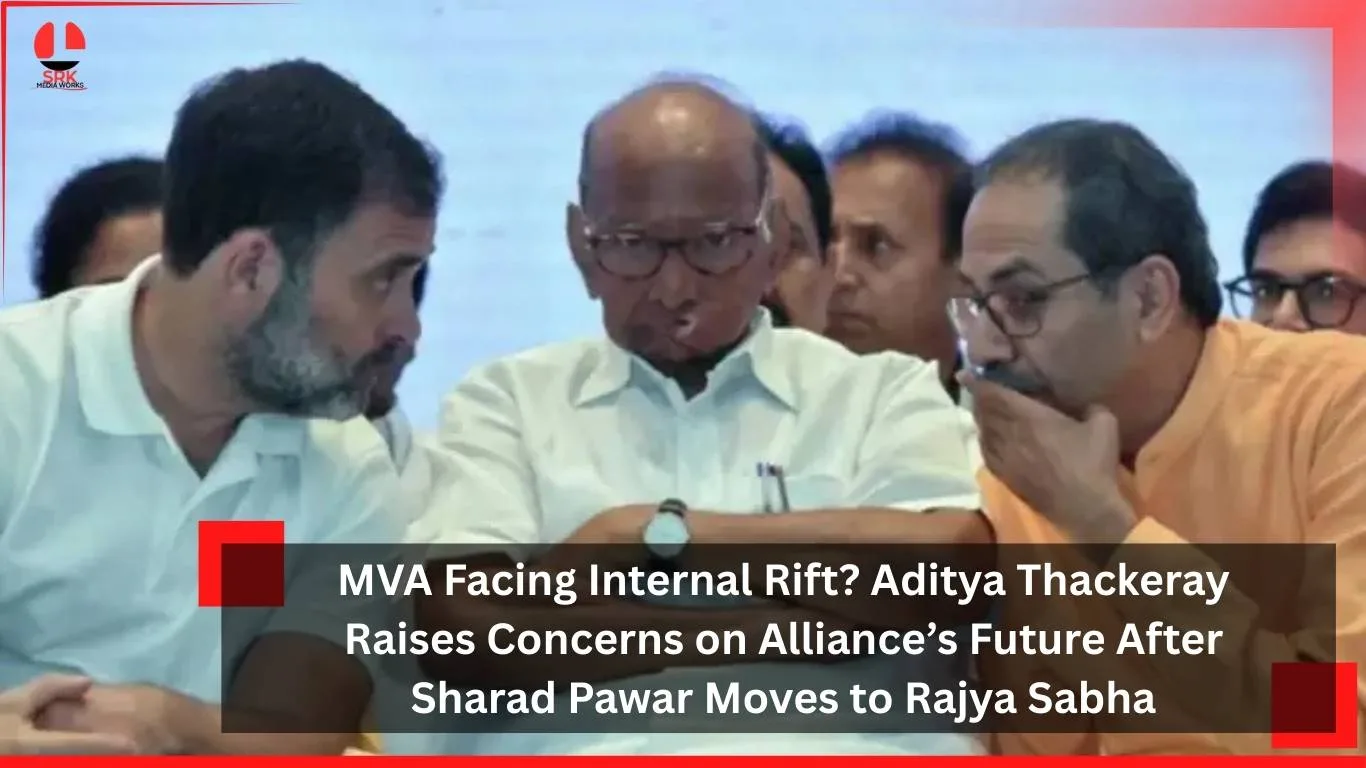
The Maha Vikas Aghadi (MVA) alliance in Maharashtra, comprising the Shiv Sena (UBT), Nationalist Congress Party (NCP), and Congress, is facing renewed speculation about its stability. Aditya Thackeray’s recent remarks questioning the alliance’s future after Sharad Pawar’s move to the Rajya Sabha have sparked debates about whether internal rifts are widening within the coalition.
Context of Sharad Pawar’s Rajya Sabha Move
Sharad Pawar, the veteran NCP leader and one of the architects of the MVA alliance, recently transitioned to the Rajya Sabha. While the move was seen as a strategic decision to strengthen his party’s presence at the national level, it has raised questions about his role in Maharashtra politics.
Aditya Thackeray, a prominent leader of Shiv Sena (UBT), expressed concerns that Pawar’s shift might weaken the alliance’s cohesion in the state. His remarks have been interpreted as a warning about potential instability within the coalition, especially as Maharashtra heads into crucial electoral battles.
Aditya Thackeray’s Concerns
Aditya Thackeray highlighted that the alliance was built on mutual trust and shared opposition to the BJP’s dominance. He suggested that Pawar’s reduced involvement in state-level politics could create gaps in coordination and strategy.
His statement reflects the anxiety within Shiv Sena (UBT) about maintaining unity in the face of BJP’s aggressive campaign machinery. Thackeray’s words also underline the delicate balance of power within the MVA, where each party plays a critical role in sustaining the coalition.
Historical Background of MVA Alliance
The MVA was formed in 2019 after the Shiv Sena broke ties with the BJP post-assembly elections. The alliance brought together ideologically diverse parties—Shiv Sena (UBT), NCP, and Congress—under a common goal of keeping BJP out of power in Maharashtra.
Despite initial skepticism, the coalition managed to govern effectively for a period, with Uddhav Thackeray serving as Chief Minister. However, internal differences and defections eventually led to the fall of the government, paving the way for Eknath Shinde’s faction of Shiv Sena to align with BJP.
Current Challenges Facing MVA
The alliance now faces multiple challenges:
- Leadership Vacuum: Sharad Pawar’s move to the Rajya Sabha raises questions about who will anchor the alliance in Maharashtra.
- Factionalism: The split within Shiv Sena and NCP has already weakened the coalition’s strength.
- Electoral Strategy: With Lok Sabha and Assembly elections approaching, coordination among alliance partners is crucial.
- Public Perception: The BJP has consistently portrayed MVA as opportunistic, which could impact voter confidence.
Comparative Analysis of Alliance Dynamics
| Party | Key Leader | Current Role in MVA | Concerns Raised |
|---|---|---|---|
| Shiv Sena (UBT) | Uddhav & Aditya Thackeray | Emotional anchor, mass appeal | Fear of weakening unity |
| NCP | Sharad Pawar | Strategic planner, veteran leader | Reduced state involvement |
| Congress | State leadership | Support base, organizational strength | Struggles with visibility |
Pivot Analysis of MVA Stability
| Dimension | Shiv Sena (UBT) | NCP | Congress |
|---|---|---|---|
| Leadership Strength | Moderate | High (but shifting) | Moderate |
| Electoral Base | Strong in Mumbai & Konkan | Strong in Western Maharashtra | Spread across regions |
| Internal Cohesion | Fragile | Divided | Moderate |
| Future Outlook | Uncertain | Strategic shift | Supportive but limited |
Political Implications
Aditya Thackeray’s concerns highlight the fragility of opposition alliances in India’s federal politics. The implications are significant:
- For Shiv Sena (UBT): The party risks losing momentum if coordination falters.
- For NCP: Pawar’s national role could strengthen the party’s profile but weaken its state-level influence.
- For Congress: The party may struggle to assert itself within the alliance, risking marginalization.
The BJP, meanwhile, is likely to exploit these tensions, portraying MVA as unstable and incapable of providing strong governance.
Broader Federal Concerns
The situation in Maharashtra reflects a larger trend in Indian politics where opposition alliances face challenges of cohesion, leadership, and strategy. Key questions include:
- Can ideologically diverse parties sustain long-term alliances?
- How do leadership transitions impact coalition stability?
- What role does public perception play in determining electoral success?
Conclusion
Aditya Thackeray’s remarks about the future of MVA after Sharad Pawar’s move to the Rajya Sabha have reignited debates about the alliance’s stability. While Pawar’s national role may strengthen NCP’s profile, it leaves a vacuum in Maharashtra politics that could destabilize the coalition.
The coming months will be crucial for MVA as it seeks to maintain unity and present a credible alternative to BJP. Whether the alliance can overcome internal rifts and project a united front will determine its political future in Maharashtra.
Disclaimer
This article is a journalistic analysis based on political statements and publicly available information. It does not represent endorsement of any political party or leader. Readers are encouraged to verify facts independently and view the content as part of ongoing democratic discourse.