
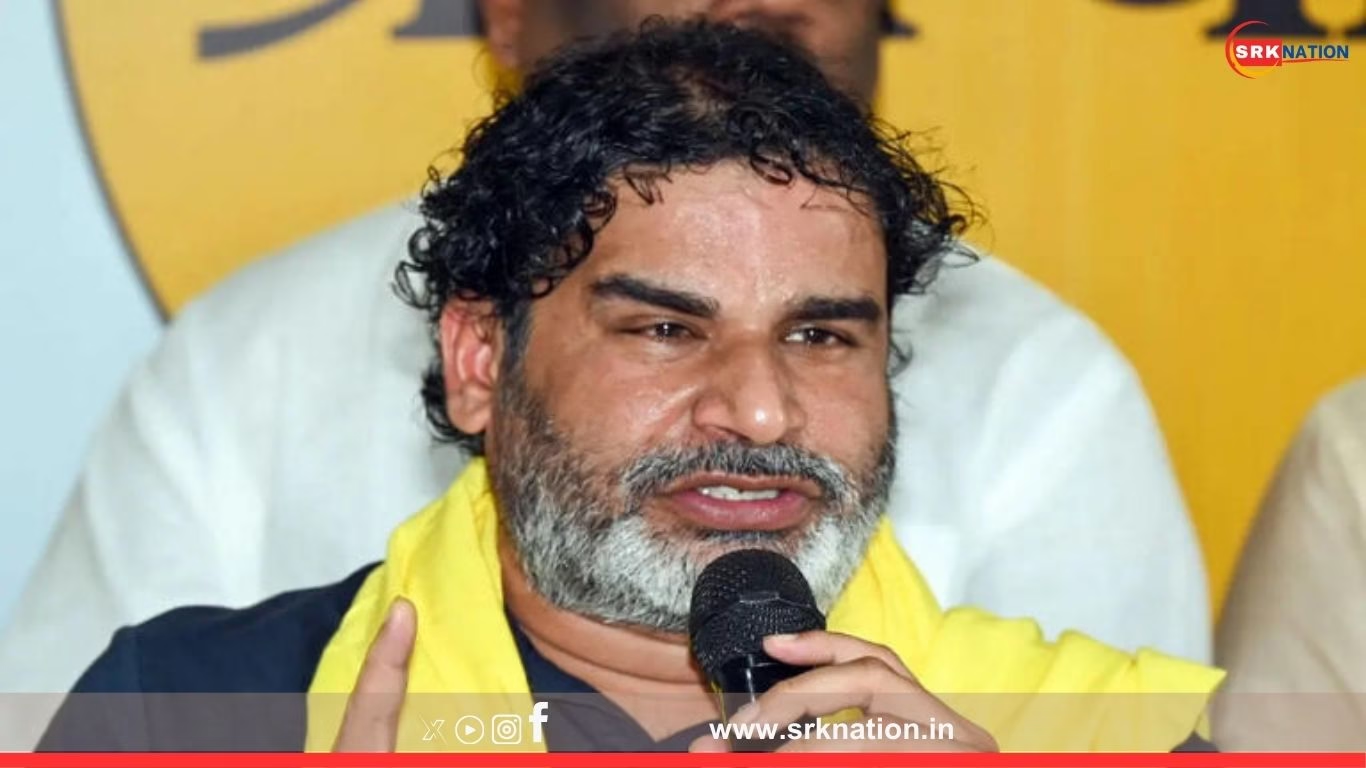
Political strategist-turned-public intellectual Prashant Kishor has once again stirred the national discourse with a bold prediction about the future of the Bharatiya Janata Party (BJP). Speaking at a public interaction in Bihar, Kishor declared, “Write it down, in 10 years, BJP’s leadership will not be what it is today.” The statement, delivered with conviction and clarity, has sparked intense speculation about the future trajectory of India’s dominant political force.
Kishor, known for his role in crafting successful election campaigns for multiple parties including BJP in 2014, has since distanced himself from active political consulting and now leads the Jan Suraaj movement in Bihar. His latest remarks were not just a critique but a forecast—suggesting that the BJP’s current leadership structure, centered around Prime Minister Narendra Modi and Home Minister Amit Shah, will undergo a significant transformation over the next decade.
While Kishor did not name any successors or speculate on who might take the reins, his assertion was clear: the BJP’s centralized leadership model will evolve, either due to generational change, internal dynamics, or shifting public expectations. “No party remains the same forever. Leadership changes, priorities shift, and new faces emerge. BJP will be no exception,” he said.
Prashant Kishor’s Key Remarks on BJP’s Future
| Statement Segment | Interpretation |
|---|---|
| “Write it down…” | Confident prediction, intended to be remembered |
| “In 10 years…” | Long-term view, not immediate political commentary |
| “Leadership will not be what it is today” | Suggests structural or generational change |
| “No party remains the same forever” | Historical context, referencing political evolution |
Kishor’s comments come at a time when the BJP is preparing for the 2026 Assembly elections in several key states, including Uttar Pradesh, Gujarat, and Bihar. The party has maintained a dominant position in national politics since 2014, winning two consecutive Lok Sabha elections and expanding its footprint across states. However, internal debates about succession planning, generational transition, and ideological recalibration have begun to surface.
Political analysts view Kishor’s statement as both a reflection of political reality and a strategic provocation. “He’s not just making a prediction—he’s inviting the public to think beyond the current leadership,” said Professor Ramesh Kumar, a political science expert at Delhi University. “It’s a subtle way of saying that the BJP’s future will depend on how it manages change.”
The BJP, for its part, has not officially responded to Kishor’s remarks. Party insiders, however, maintain that the leadership is focused on governance and electoral strategy, not speculation. “We respect all opinions, but our focus is on delivering results and winning the trust of the people,” said a senior BJP leader on condition of anonymity.
Kishor’s prediction also raises questions about the next generation of BJP leaders. Names like Yogi Adityanath, Devendra Fadnavis, Anurag Thakur, and Tejasvi Surya have been floated as potential future faces of the party. However, none have yet matched the national stature of Modi or Shah.
Potential Future Leaders in BJP – Speculative Outlook
| Leader Name | Current Role | Strengths | Challenges |
|---|---|---|---|
| Yogi Adityanath | CM of Uttar Pradesh | Mass appeal, Hindutva credentials | Polarizing image |
| Devendra Fadnavis | Deputy CM of Maharashtra | Administrative experience | Limited national reach |
| Anurag Thakur | Union Minister | Youth connect, media savvy | Needs broader grassroots support |
| Tejasvi Surya | MP from Bengaluru South | Energetic, articulate | Relatively inexperienced |
Kishor’s remarks also touch upon a broader theme—the cyclical nature of political dominance. He referenced the Congress party’s evolution from Nehru to Indira to Rajiv, and eventually to Sonia and Rahul Gandhi. “Every party has its phases. The BJP is in its peak phase now, but the next phase will be different,” he said.
The strategist’s words have found resonance among opposition leaders, many of whom see them as validation of their belief that the BJP’s dominance is not permanent. Congress spokesperson Supriya Shrinate tweeted, “Even Prashant Kishor knows the Modi-Shah era won’t last forever. India deserves fresh leadership.”
However, Kishor was quick to clarify that his statement was not a critique of Modi or Shah personally. “They have done what few leaders could—build a national party with deep roots. But leadership is not static. It evolves,” he said.
His comments also come amid growing public discourse on leadership fatigue, generational change, and the need for new narratives in Indian politics. With the youth comprising over 50% of India’s population, political parties are under pressure to present leaders who resonate with younger voters.
India’s Political Leadership Evolution – Historical Timeline
| Era | Dominant Leader | Party | Transition Outcome |
|---|---|---|---|
| 1950s–1960s | Jawaharlal Nehru | Congress | Smooth transition to Indira |
| 1980s | Rajiv Gandhi | Congress | Rise of coalition politics |
| 1990s | Atal Bihari Vajpayee | BJP | Emergence of regional parties |
| 2010s–2020s | Narendra Modi | BJP | Centralized leadership model |
| 2030s? | TBD | TBD | Awaiting generational shift |
Kishor’s prediction may not be universally accepted, but it has certainly reignited conversations about the future of Indian politics. Whether his words prove prophetic or not, they underscore the importance of adaptability, renewal, and vision in political leadership.
As India heads into another cycle of elections and policy debates, the spotlight will remain on how parties—especially the BJP—prepare for the next decade. Kishor’s challenge to “write it down” is not just a forecast—it’s a call to observe, analyze, and anticipate.
Disclaimer: This article is based on publicly available statements, media reports, and political commentary. It does not reflect any political stance or endorsement. All quotes are attributed to public figures as per coverage. The content is intended for editorial and informational purposes only.