




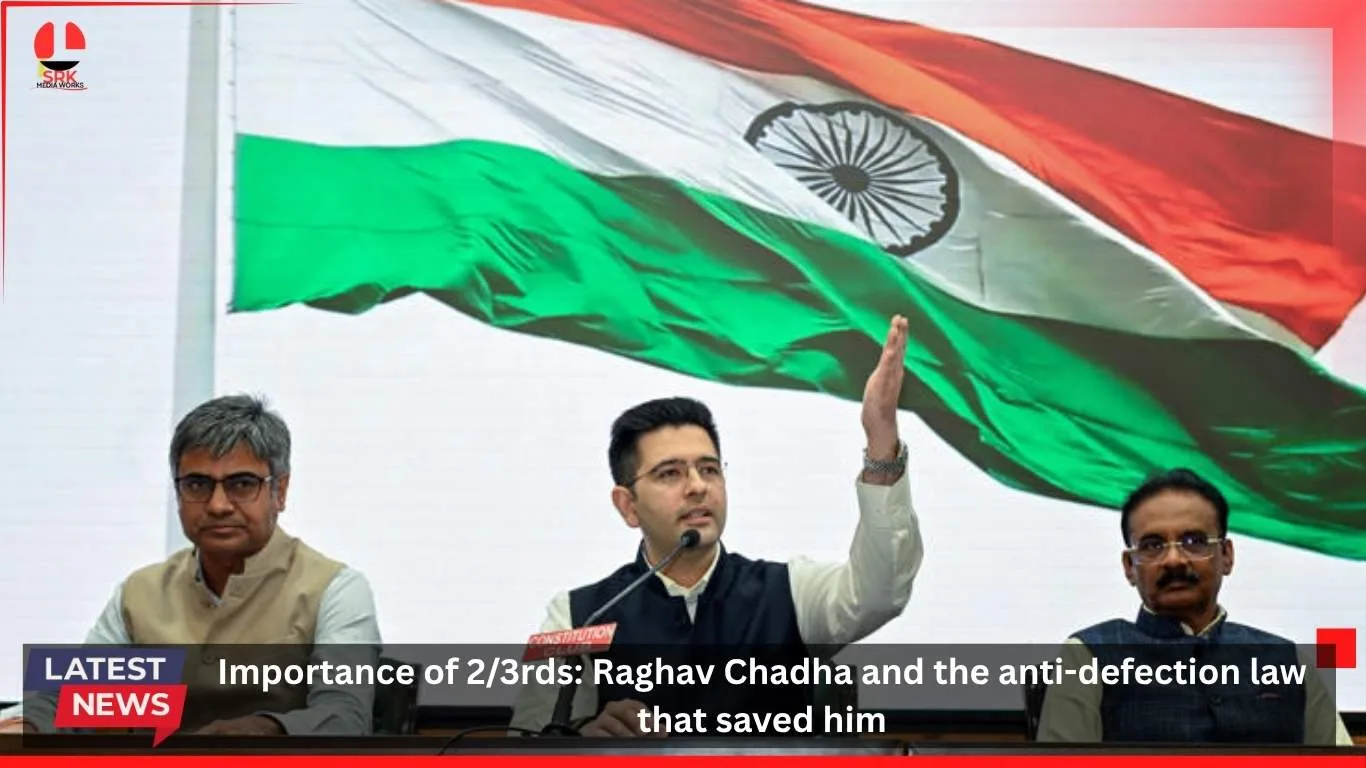
The political spotlight has turned to Aam Aadmi Party (AAP) leader Raghav Chadha, whose position in the Rajya Sabha was safeguarded by the constitutional provisions of India’s anti-defection law. The case highlights the critical importance of the two-thirds majority requirement under the Tenth Schedule of the Constitution, which has often determined the fate of legislators facing disqualification attempts.
The Anti-Defection Law
The anti-defection law, enacted in 1985 through the 52nd Amendment, was designed to curb political instability caused by frequent defections. It mandates that legislators can be disqualified if they defect from their party, unless a merger is supported by at least two-thirds of the members of the legislature party.
Key Provisions:
- Disqualification if a member voluntarily gives up party membership.
- Disqualification if a member votes against party directives.
- Exception: Merger supported by two-thirds of members is protected.
Raghav Chadha’s Case
Chadha faced attempts to disqualify him from the Rajya Sabha, but the two-thirds requirement under the anti-defection law ensured his survival. The law prevented a smaller faction from engineering his removal, safeguarding his position and reinforcing the principle of majority consensus.
Comparative Analysis
| Aspect | Without Anti-Defection Law | With Anti-Defection Law |
|---|---|---|
| Stability | Frequent defections, instability | Greater stability, reduced defections |
| Chadha’s Position | Vulnerable to factional moves | Protected by two-thirds requirement |
| Party Discipline | Weak, prone to manipulation | Stronger, ensures loyalty |
Importance of the Two-Thirds Rule
The two-thirds rule is the cornerstone of the anti-defection law. It ensures that only a substantial majority can legitimize a merger or defection, preventing small groups from destabilizing parties. In Chadha’s case, this provision was decisive in safeguarding his membership.
Pivot Analysis: Two-Thirds Rule vs. Political Stability
| Factor | Impact Without Rule | Impact With Rule |
|---|---|---|
| Party Discipline | Weak, prone to manipulation | Strong, ensures loyalty |
| Legislative Stability | Frequent instability | Greater stability, reduced defections |
| Individual Protection | Vulnerable to factional moves | Protected from arbitrary disqualification |
Political Reactions
The case has sparked debate across political circles. Supporters of Chadha argue that the law upheld democratic principles, while critics claim it shields politicians from accountability.
Reactions Overview
| Group/Community | Reaction to Chadha’s Survival | Potential Impact |
|---|---|---|
| AAP Supporters | Positive, see it as victory for democracy | Strengthens party morale |
| Opposition Parties | Critical, call it misuse of law | Reinforces demand for reforms |
| Legal Experts | Highlight importance of constitutional safeguards | Shapes discourse on law’s relevance |
| Neutral Observers | Mixed, focus on balance between stability and accountability | Adds complexity to debate |
Historical Context
The anti-defection law has played a pivotal role in Indian politics since its inception. From state assemblies to Parliament, the two-thirds rule has often determined whether defections succeed or fail. Chadha’s case is the latest example of how constitutional safeguards continue to shape political outcomes.
Implications for Future Politics
The case underscores the enduring relevance of the anti-defection law. While it has been criticized for limiting dissent, it remains a vital tool for ensuring stability. Chadha’s survival highlights how the two-thirds rule can protect legislators from factional politics.
Looking ahead:
- Party Discipline: Law will continue to enforce loyalty.
- Political Stability: Two-thirds rule will prevent arbitrary defections.
- Debate on Reform: Calls for balancing accountability with stability may intensify.
Conclusion
Raghav Chadha’s survival in the Rajya Sabha demonstrates the critical importance of the two-thirds requirement under India’s anti-defection law. By safeguarding legislators from arbitrary disqualification, the law reinforces stability and party discipline. While debates about reform persist, the case highlights how constitutional provisions continue to shape the dynamics of Indian politics.
Disclaimer
This article is based on publicly available political commentary and constitutional analysis. It does not represent endorsement or criticism of any individual or party. The content is intended for informational purposes only, highlighting the dynamics of law, politics, and public perception. Readers are encouraged to explore diverse perspectives before forming conclusions.