

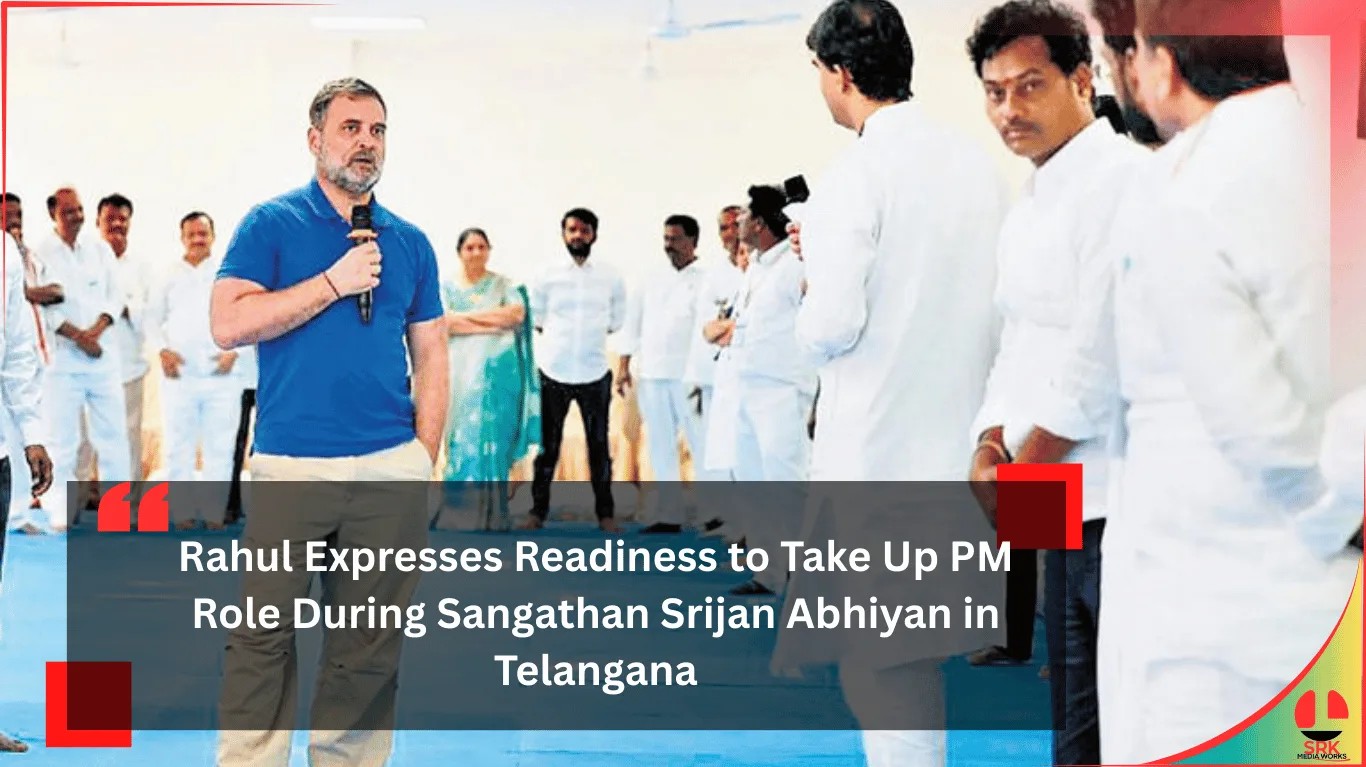
During the Sangathan Srijan Abhiyan in Telangana, Congress leader Rahul Gandhi expressed his readiness to assume the role of Prime Minister if the party and the people of India entrusted him with the responsibility. His remarks have sparked intense political debate, with supporters viewing it as a sign of confidence and critics framing it as a strategic move ahead of upcoming elections.
Context of the Statement
Rahul Gandhi’s declaration came during a key organizational campaign aimed at strengthening Congress’s grassroots presence in Telangana. The Sangathan Srijan Abhiyan focuses on restructuring party units, mobilizing cadres, and preparing for electoral battles. Gandhi’s statement about his willingness to take up the PM role was seen as both a motivational message to party workers and a broader signal to the electorate.
Key Highlights
- Rahul Gandhi’s Readiness: Expressed willingness to lead the nation as Prime Minister.
- Organizational Drive: Sangathan Srijan Abhiyan aims to strengthen Congress’s base in Telangana.
- Political Reactions: Supporters hailed the statement, while rivals criticized it as opportunistic.
- Electoral Context: Comes ahead of crucial state and national elections.
Comparative Analysis of Leadership Aspirations
| Leader | Statement/Position | Public Perception | Impact on Party |
|---|---|---|---|
| Rahul Gandhi | Expressed readiness for PM role | Divided – admired by supporters, criticized by rivals | Boosts morale among cadres |
| Narendra Modi | Established as PM candidate | Strong leadership image | Consolidates BJP’s base |
| Regional Leaders | Focused on state politics | Limited national appeal | Strengthens local influence |
Pivot Analysis of Political Sentiment
| Sentiment Category | Impact on Congress | Impact on Telangana Politics | Impact on National Politics |
|---|---|---|---|
| Supporter Morale | Boosted – Gandhi seen as confident | Strengthens Congress’s local presence | Positions Gandhi as national contender |
| Media Coverage | Extensive – highlights leadership claim | Focus on Telangana campaign | National debate on Congress’s future |
| Opposition Strategy | Rivals criticize Gandhi’s statement | BJP and regional parties gain talking points | Alters opposition dynamics |
| Voter Perception | Mixed – some see confidence, others doubt capability | May influence local voter sentiment | Shapes national narrative on leadership |
Challenges Ahead for Rahul Gandhi
While his statement has energized Congress cadres, Rahul Gandhi faces several challenges:
- Public Trust: Convincing voters of his leadership capabilities.
- Party Unity: Ensuring internal cohesion within Congress.
- Electoral Strategy: Crafting a winning narrative against BJP’s dominance.
- Opposition Pressure: Countering criticism from rivals who question his readiness.
Opportunities for Congress
Rahul Gandhi’s readiness to take up the PM role also presents opportunities:
- Youth Engagement: Attracting younger voters through a fresh leadership appeal.
- Policy Focus: Emphasizing governance, welfare, and development.
- Alliance Building: Strengthening ties with regional parties to form a united opposition.
- National Visibility: Positioning Gandhi as a credible alternative on the national stage.
Broader Implications
Rahul Gandhi’s statement has implications beyond Telangana:
- National Opposition: Reinforces Congress’s claim to leadership within the opposition bloc.
- Electoral Dynamics: Shapes voter perceptions ahead of national elections.
- Public Narrative: Highlights Congress’s intent to project Gandhi as a prime ministerial candidate.
Conclusion
Rahul Gandhi’s expression of readiness to take up the Prime Minister’s role during the Sangathan Srijan Abhiyan in Telangana marks a critical moment in Congress’s political journey. While supporters view it as a sign of confidence and determination, critics see it as a calculated move. The statement underscores Congress’s intent to position Gandhi as a national leader, setting the stage for intense political battles in the months ahead.
Disclaimer
This article is a journalistic analysis based on publicly available information and political developments. It does not endorse or oppose any political party or leader. Readers are encouraged to interpret the content as informative coverage and verify facts independently before forming opinions.