



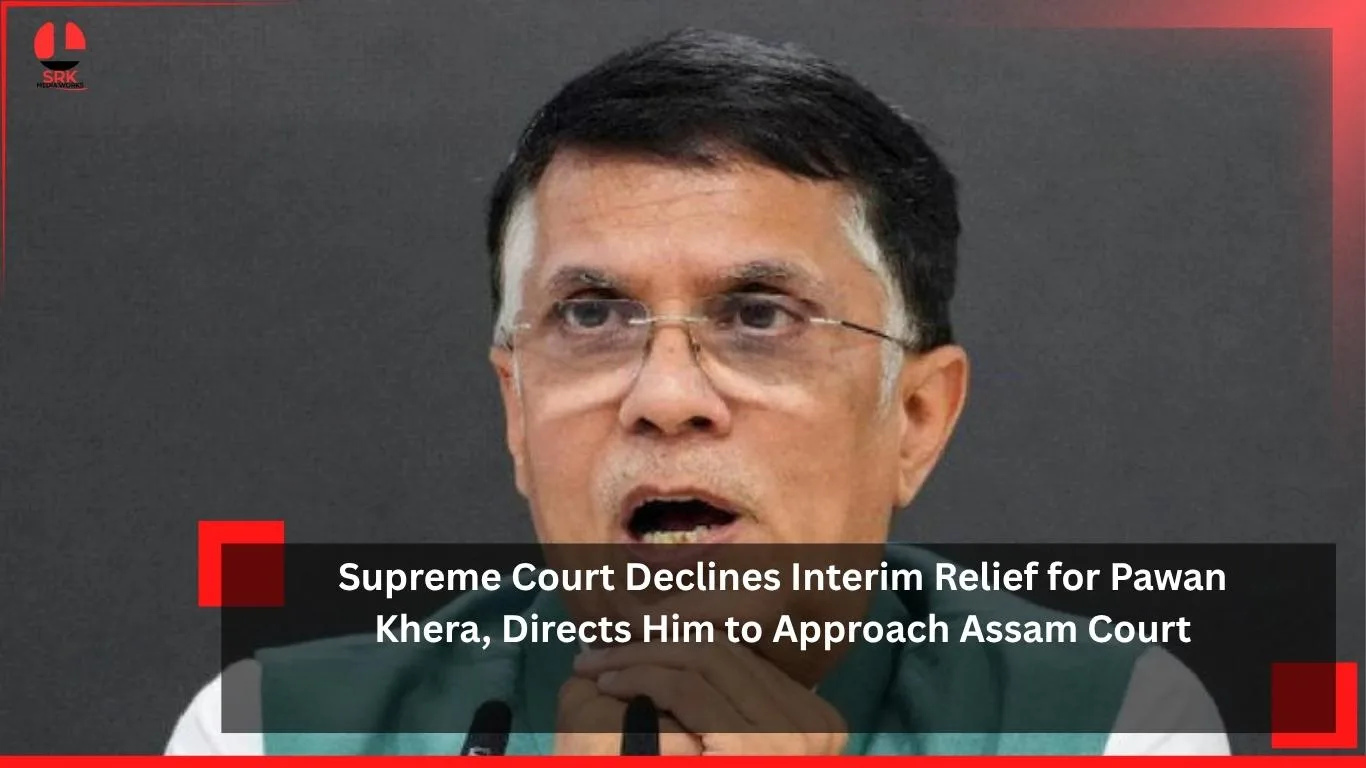
The Supreme Court of India has declined to grant interim relief to Congress leader Pawan Khera in connection with a case filed against him in Assam. The apex court has instead directed him to approach the appropriate court in Assam for remedies. This development has sparked significant political and legal discussions, given the high-profile nature of the case and the broader implications for freedom of speech and political accountability in India.
Background of the Case
Pawan Khera, a senior spokesperson of the Indian National Congress, has been embroiled in controversy following remarks he made that allegedly offended certain political groups. A case was registered against him in Assam, leading to legal proceedings that have now reached the Supreme Court. His plea for interim relief was aimed at securing protection from arrest and immediate legal consequences while the matter was being adjudicated.
The Supreme Court, however, emphasized that the appropriate jurisdiction lies with the Assam court, thereby reinforcing the principle of federal judicial responsibility. This decision underscores the judiciary’s stance on ensuring that cases are heard in the relevant territorial jurisdiction rather than being centralized in New Delhi.
Key Highlights of the Supreme Court’s Decision
- No Interim Relief Granted: The Supreme Court refused to provide temporary protection to Pawan Khera.
- Jurisdictional Clarity: The court directed him to approach the Assam court, where the case was originally filed.
- Legal Precedent: The decision reinforces the importance of respecting territorial jurisdiction in criminal matters.
- Political Impact: The ruling has intensified debates on political speech, accountability, and the role of courts in balancing free expression with legal responsibility.
Political Reactions
The ruling has triggered strong reactions across the political spectrum:
- Congress Party: Leaders have expressed disappointment, arguing that the case is politically motivated and aimed at silencing dissent.
- BJP Leaders: They have welcomed the decision, stating that the law must take its course and that no individual is above legal scrutiny.
- Legal Experts: Analysts have noted that the Supreme Court’s refusal to intervene at this stage is consistent with judicial norms, as interim relief is not automatically granted in politically sensitive cases.
Legal Implications
The case raises important questions about the balance between free speech and defamation laws in India. While political leaders often engage in sharp rhetoric, the judiciary has repeatedly emphasized that freedom of speech does not extend to defamatory or inflammatory remarks. The Supreme Court’s decision signals that politicians must be prepared to face legal consequences for their statements.
Comparative Analysis of Judicial Responses
| Case | Political Leader | Court’s Response | Outcome |
|---|---|---|---|
| Pawan Khera (2026) | Congress | SC declined interim relief | Directed to Assam court |
| Navjot Singh Sidhu (2018) | Congress | SC granted partial relief | Sentence reduced |
| Azam Khan (2020) | SP | SC refused relief | Case continued in UP |
| Rahul Gandhi (2023) | Congress | SC stayed conviction temporarily | Allowed appeal |
This comparative view highlights how the judiciary has varied its responses depending on the nature of the case, the gravity of the allegations, and the jurisdiction involved.
Broader Context: Free Speech vs. Accountability
India’s democratic framework guarantees freedom of speech under Article 19(1)(a) of the Constitution. However, this right is subject to reasonable restrictions, including defamation, public order, and decency. The Pawan Khera case exemplifies the tension between political expression and legal accountability.
Key Factors Influencing Judicial Decisions
| Factor | Impact on Case |
|---|---|
| Jurisdiction | Determines which court has authority |
| Nature of Remarks | Offensive or defamatory remarks attract legal scrutiny |
| Political Sensitivity | Courts exercise caution in politically charged cases |
| Precedent | Past rulings influence current decisions |
Public Sentiment
Public opinion on the matter is divided. Supporters of Pawan Khera argue that the case is an attempt to stifle opposition voices, while critics maintain that politicians must be held accountable for their words. Social media platforms have seen heated debates, with hashtags trending both in support of and against Khera.
Future Course of Action
Pawan Khera is now expected to approach the Assam court for relief. His legal team will likely argue that the case is politically motivated and that his remarks fall within the ambit of free speech. The Assam court’s decision will be crucial in determining the trajectory of the case.
Conclusion
The Supreme Court’s refusal to grant interim relief to Pawan Khera marks a significant moment in India’s judicial and political landscape. It reinforces the principle of jurisdictional propriety while highlighting the ongoing debate over free speech and accountability. As the case proceeds in Assam, it will continue to attract national attention and shape discussions on the limits of political discourse in India.
Disclaimer
This news article is a detailed analytical report based on publicly available information and judicial developments. It is intended for informational purposes only and does not constitute legal advice or political endorsement. Readers are encouraged to verify facts independently and consider multiple perspectives before forming conclusions.