









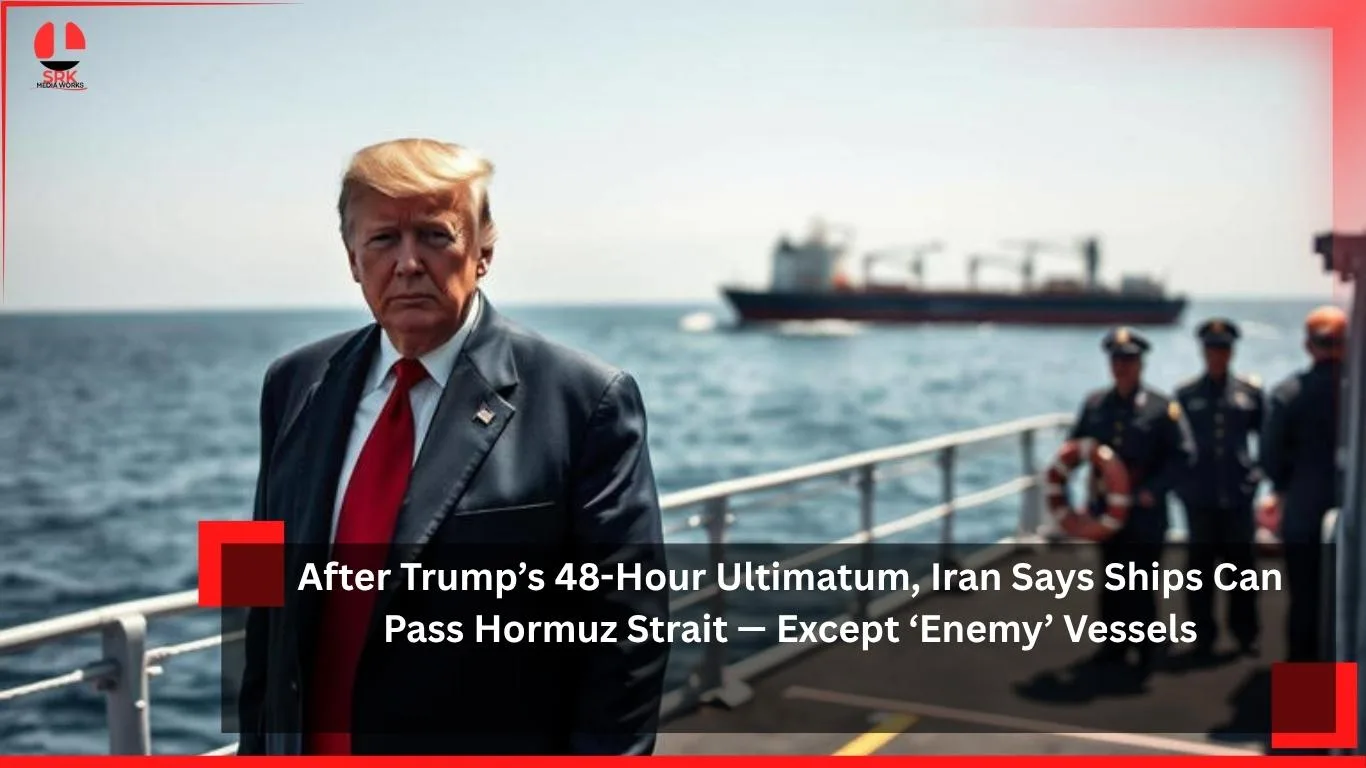
The Strait of Hormuz, one of the world’s most critical maritime chokepoints, has once again become the center of geopolitical tension. Following U.S. President Donald Trump’s 48-hour ultimatum demanding unrestricted passage for international vessels, Iran has responded with a conditional allowance: ships may pass freely, but “enemy vessels” will face restrictions.
The Strategic Importance of the Strait of Hormuz
The Strait of Hormuz is a narrow waterway connecting the Persian Gulf to the Arabian Sea. It is vital for global energy security, as nearly 20% of the world’s oil supply transits through this route. Any disruption has immediate consequences for global markets.
Iran’s stance, allowing passage but excluding “enemy vessels,” introduces ambiguity. While commercial ships may continue operations, military vessels from nations deemed hostile could face confrontation.
Trump’s Ultimatum
President Trump’s 48-hour ultimatum was aimed at ensuring freedom of navigation. His administration has consistently emphasized that the U.S. will not tolerate restrictions in international waters. The ultimatum was seen as a direct challenge to Iran’s authority in the region.
Iran’s Response
Iran’s statement reflects both defiance and pragmatism:
- Defiance: By excluding “enemy vessels,” Iran asserts its sovereignty and strategic leverage.
- Pragmatism: Allowing commercial ships to pass avoids immediate economic backlash and maintains a semblance of compliance with international norms.
Comparative Analysis of Strait of Hormuz Tensions
| Year | Trigger Event | Iran’s Position | Global Impact |
|---|---|---|---|
| 2012 | Sanctions escalation | Threatened closure | Oil prices surged |
| 2019 | Tanker attacks | Denied involvement | Heightened military presence |
| 2026 | Trump ultimatum | Conditional passage | Market volatility |
This timeline shows recurring tensions, with 2026 marking a new phase of conditional navigation.
Pivot Analysis: Stakeholders Affected
| Stakeholder | Impact Type | Strategic Consequence |
|---|---|---|
| Global Oil Markets | Price volatility | Increased energy costs |
| Shipping Companies | Operational uncertainty | Higher insurance premiums |
| U.S. Military | Potential confrontation | Escalation risk |
| Regional Nations | Security concerns | Pressure to align with allies |
Broader Geopolitical Implications
- For the U.S.: Trump’s ultimatum signals a hardline stance, reinforcing America’s role as a global maritime enforcer.
- For Iran: The conditional allowance demonstrates Iran’s balancing act between confrontation and economic pragmatism.
- For Global Trade: Shipping companies face uncertainty, with insurance costs likely to rise.
- For Energy Markets: Oil prices may fluctuate as traders react to potential disruptions.
Possible Outcomes
- De-escalation: Diplomatic negotiations could lead to clearer agreements on passage.
- Escalation: Any confrontation involving “enemy vessels” could spark military conflict.
- Economic Ripple: Even without direct conflict, uncertainty may drive oil prices upward.
Conclusion
The announcement that Iran will allow ships to pass through the Strait of Hormuz except for “enemy vessels,” following Trump’s 48-hour ultimatum, underscores the fragile balance of power in one of the world’s most critical waterways.
While commercial shipping may continue, the exclusion of certain military vessels raises the risk of confrontation. The coming weeks will determine whether this standoff leads to negotiation or escalation, but the global implications are already being felt in energy markets and diplomatic circles.
Disclaimer: This article is based on reported geopolitical developments and public statements. It is intended for informational purposes only and does not represent official government policy or classified intelligence. Readers should follow verified updates for final outcomes.