







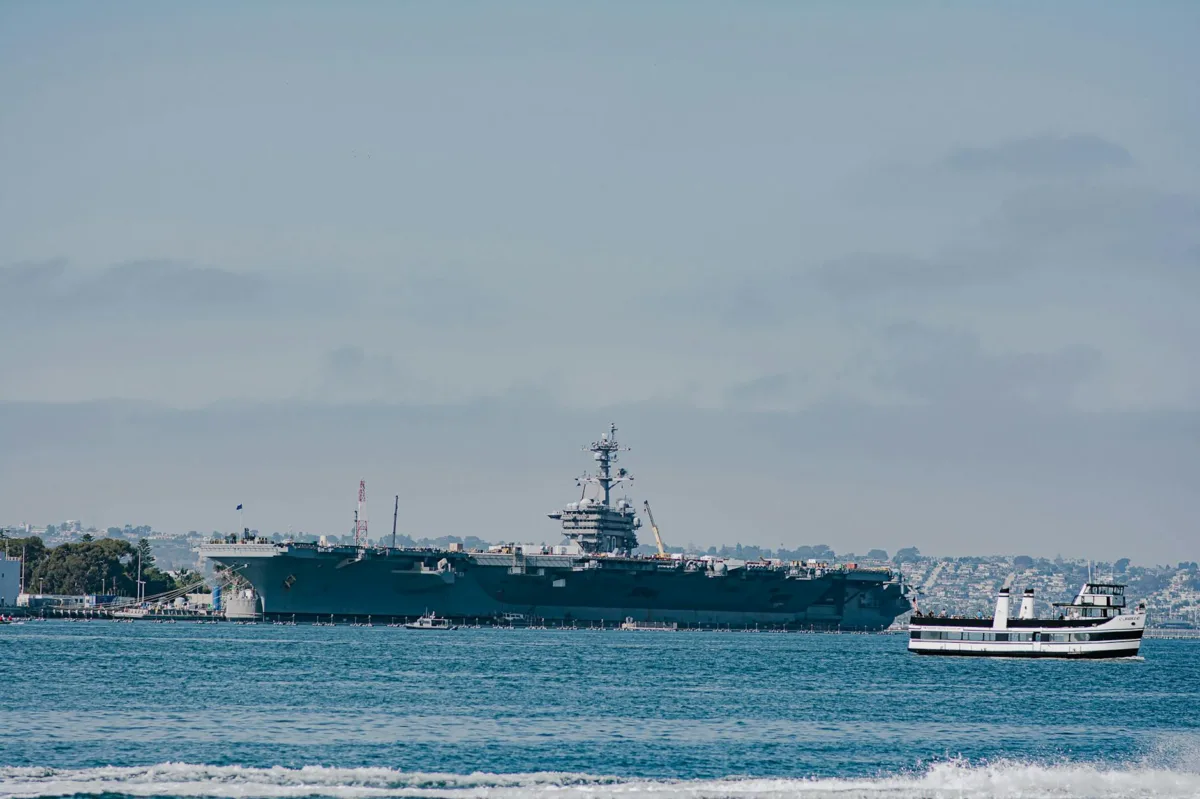
The Return of the Carrier Strike Group
The USS Gerald R. Ford (CVN-78), the Navy’s newest and most advanced aircraft carrier, returned to its homeport in Norfolk, Virginia, this week, marking the conclusion of an grueling 11-month deployment. Accompanied by two guided-missile destroyers, the carrier strike group arrived to a crowd of roughly 5,000 family members and service personnel, ending a mission that began in June of last year.
This deployment served as a critical component of U.S. maritime strategy, specifically focusing on regional stabilization efforts in the Middle East following the outbreak of conflict in Iran. Furthermore, the strike group played a pivotal role in the high-stakes operation that led to the capture of Venezuelan leader Nicolás Maduro, demonstrating the Navy’s capacity to project power across multiple theaters of operation simultaneously.
Operational Context and Global Reach
The USS Gerald R. Ford, commissioned in 2017, represents a generational leap in naval technology, featuring the Electromagnetic Aircraft Launch System (EMALS) and a significantly upgraded nuclear reactor plant. This deployment was initially intended to be a routine six-month rotation, but the rapid escalation of geopolitical tensions necessitated multiple extensions by the Department of Defense.
By maintaining a persistent presence in the Eastern Mediterranean and the Caribbean, the strike group served as a deterrent against potential regional adversaries. The extended duration of the mission pushed the crew and the ship’s advanced systems to their operational limits, providing the Navy with unprecedented data on the sustainability of the Ford-class design in real-world combat environments.
Strategic Impact and Operational Success
The mission’s success in both the Iranian theater and the Venezuelan operation highlights a shift toward more flexible, multi-mission naval tasking. Military analysts note that the ability to pivot between conflict zones underscores the strategic utility of mobile sea-based air power.
According to U.S. Naval Institute reports, the strike group logged thousands of flight hours, providing constant surveillance and strike capability in volatile regions. The successful capture of Maduro, in particular, was facilitated by the carrier’s specialized intelligence, surveillance, and reconnaissance (ISR) capabilities, which monitored logistical movements in the Caribbean with precision.
Expert Perspectives on Fleet Readiness
Defense experts emphasize that the 11-month timeline places significant strain on both equipment and personnel morale. “Extended deployments are a double-edged sword,” says Dr. Aris Thorne, a naval analyst at the Center for Strategic and Budgetary Assessments. “While the ship proved its mettle in high-intensity scenarios, the Navy must now contend with a massive maintenance backlog and the need for personnel recovery to ensure fleet readiness for future contingencies.”
Data from the Department of the Navy indicates that the ship’s operational availability exceeded 90 percent during the deployment, a figure that exceeds expectations for a vessel still in its early stages of its service life. This performance suggests that the Ford-class carrier is successfully transitioning from an experimental platform to a reliable cornerstone of the U.S. carrier fleet.
Future Implications and Outlook
As the crew begins their post-deployment leave, the Navy is already shifting its focus to the extensive maintenance and modernization cycles required for the vessel. The lessons learned from this deployment will likely dictate the operational tempo and maintenance schedules for the upcoming USS John F. Kennedy, the second ship in the Ford class.
Observers should watch for upcoming congressional hearings regarding the sustainability of these extended deployment models. As the U.S. faces a more competitive global security environment, the balance between maintaining a forward-deployed presence and preserving the longevity of its most advanced assets will remain a central point of debate for defense planners in the coming fiscal year.