








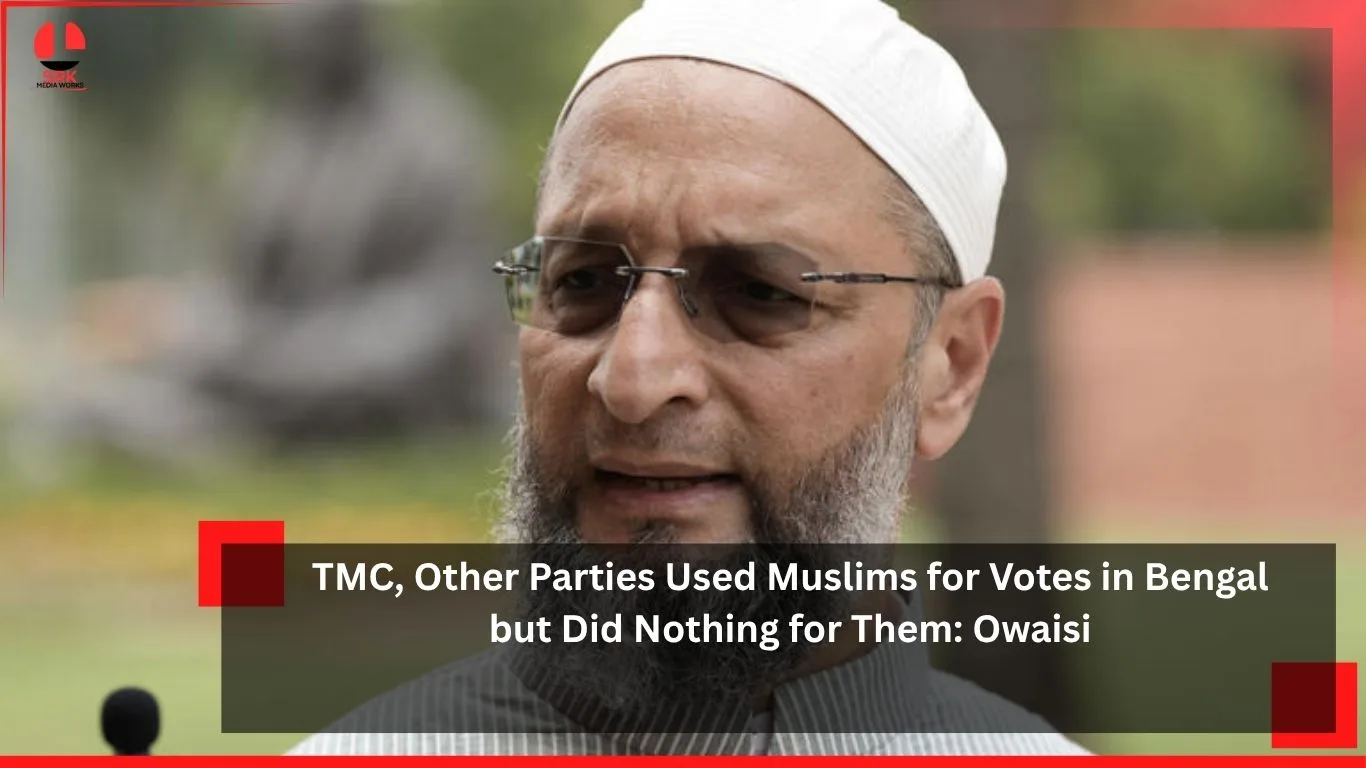
All India Majlis-e-Ittehad-ul-Muslimeen (AIMIM) chief Asaduddin Owaisi has launched a sharp attack on the Trinamool Congress (TMC) and other political parties in West Bengal, accusing them of exploiting Muslim voters for electoral gains without delivering meaningful development or welfare. His remarks, made during a rally in Kolkata, have reignited debates about minority politics, representation, and accountability in the state.
Owaisi’s Statement
Owaisi alleged that while Muslims form a significant portion of West Bengal’s electorate, successive governments have failed to address their socio-economic concerns. He claimed that political parties, including the TMC, have used Muslims as a “vote bank” but ignored their needs once elections were over.
- Quote: “Muslims in Bengal have been used for votes, but no one has done anything for them.”
- Target: Primarily the TMC, but also other regional and national parties.
- Context: Delivered during AIMIM’s campaign outreach in Bengal ahead of upcoming elections.
Muslim Demographics in West Bengal
Muslims constitute nearly 27% of West Bengal’s population, making them a crucial voting bloc. Their presence is particularly strong in districts such as Murshidabad, Malda, and North Dinajpur.
| District | Muslim Population (%) | Political Significance |
|---|---|---|
| Murshidabad | 66 | Stronghold of minority votes |
| Malda | 51 | Key battleground district |
| North Dinajpur | 49 | Swing constituency |
| Kolkata | 20 | Urban minority presence |
Owaisi’s Political Strategy
Owaisi’s remarks are part of AIMIM’s broader strategy to expand its footprint in eastern India.
- Focus: Minority representation and empowerment.
- Approach: Position AIMIM as an alternative to mainstream parties.
- Goal: Mobilize Muslim voters who feel neglected by traditional political outfits.
Comparative Analysis: Party Approaches Toward Muslim Voters
| Party | Strategy Toward Muslims | Criticism Faced |
|---|---|---|
| TMC | Welfare schemes, symbolic gestures | Accused of tokenism |
| Congress | Historical minority support | Declining influence |
| BJP | Focus on majority politics | Limited minority outreach |
| AIMIM | Direct representation | Criticized for vote-splitting |
Reactions to Owaisi’s Remarks
- TMC Response: Leaders dismissed Owaisi’s comments as politically motivated.
- Opposition Parties: Some echoed concerns about minority neglect but accused AIMIM of dividing votes.
- Civil Society: Analysts noted that while Owaisi’s critique resonates with many, AIMIM’s ability to convert rhetoric into electoral success remains uncertain.
Broader Implications
- Electoral Dynamics: Owaisi’s entry could reshape minority voting patterns in Bengal.
- Party Accountability: His remarks highlight the need for parties to deliver beyond electoral promises.
- Minority Politics: The debate underscores the challenges of balancing representation with development.
Conclusion
Asaduddin Owaisi’s sharp criticism of TMC and other parties for allegedly using Muslims as a vote bank without delivering tangible benefits has added a new dimension to West Bengal’s political discourse. Whether AIMIM can translate this rhetoric into electoral gains remains to be seen, but the remarks have already sparked discussions about accountability, representation, and the future of minority politics in the state.
Disclaimer
This article is based on publicly available political statements and analysis. It is intended for informational purposes only and does not constitute political endorsement, financial advice, or professional guidance. Readers are encouraged to verify details independently and follow official sources for updates on electoral developments.