







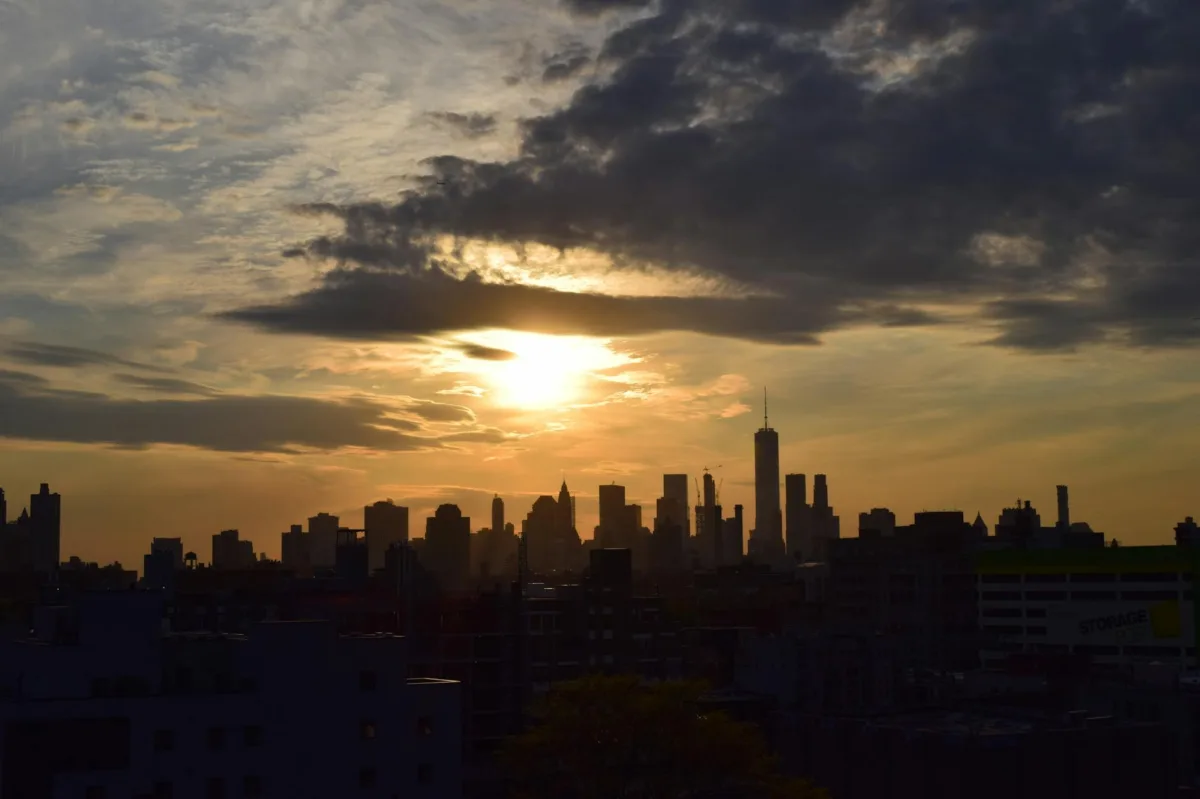
Twice each year, New York City transforms into a celestial observatory as the setting sun perfectly aligns with the Manhattan street grid, creating a phenomenon known as Manhattanhenge. Occurring typically in late May and mid-July, this event draws thousands of spectators to the city’s east-west thoroughfares to witness the solar disk resting squarely between the rows of steel and glass skyscrapers.
The Geometry of the Grid
The term Manhattanhenge was coined by astrophysicist Neil deGrasse Tyson, who drew a comparison to the prehistoric Stonehenge monument in England. The phenomenon is made possible by the unique layout of Manhattan’s 1811 Commissioners’ Plan, which established a grid that is rotated 29 degrees clockwise from true east-west.
Because the street grid is not perfectly aligned with cardinal directions, the sunset only aligns with the grid when the sun’s azimuth matches the angle of the streets. This geometric precision ensures that for a few minutes, the light of the setting sun illuminates the entire length of the cross-town streets, creating a dramatic, high-contrast visual display.
A Cultural Phenomenon
What began as a niche interest for amateur astronomers has evolved into a major cultural event in New York City. Major streets such as 14th, 23rd, 34th, 42nd, and 57th streets consistently host the largest crowds, with 42nd Street often cited as the most popular vantage point due to its proximity to the Chrysler Building and other iconic architecture.
Data from the American Museum of Natural History indicates that the optimal viewing times occur just before the summer solstice. While the full sun alignment—where the entire solar disk sits on the horizon—is the most sought-after shot, the “half sun” alignment also provides a spectacular visual experience for observers.
Scientific and Urban Perspectives
Urban planners and historians note that the grid system, while often criticized for its rigidity, was designed for efficiency and commerce rather than astronomical alignment. The fact that it happens to align with the sun twice a year is considered a serendipitous byproduct of the island’s geography and the city’s architectural density.
Photography experts emphasize that the event requires specific timing and clear skies to be visible. Atmospheric conditions, such as cloud cover or haze over the Hudson River, can often obscure the view, turning a highly anticipated event into a test of patience for local shutterbugs.
Future Implications for Urban Tourism
As social media continues to amplify the visibility of Manhattanhenge, local authorities have increasingly had to manage pedestrian traffic and public safety on major thoroughfares. The event highlights the growing intersection between urban infrastructure and viral tourism, where natural phenomena are commodified into experiences that drive local foot traffic.
Observers should monitor the American Museum of Natural History’s official calendar for precise dates in the coming year, as the exact timing shifts slightly due to the earth’s orbital mechanics. As the city continues to develop, the preservation of sightlines along these major cross-streets remains a point of interest for urban preservationists concerned with how new construction might eventually obstruct the view of this biannual spectacle.